 Log in


Researchers evaluated how well an AI model could diagnose and make decisions about patient care.
(Image credit: shapecharge/E+)


|
Pragmatic idealist. Worked on Ubuntu Phone. Inkscape co-founder. Probably human.
|
Researchers evaluated how well an AI model could diagnose and make decisions about patient care.
(Image credit: shapecharge/E+)


The next Donald Trump memecoin event could very well be the last.
If Democrats retake control of Congress this fall, they may succeed in quickly passing legislation banning the president and his family from profiting from the shady token that has deeply disturbed government ethicists.
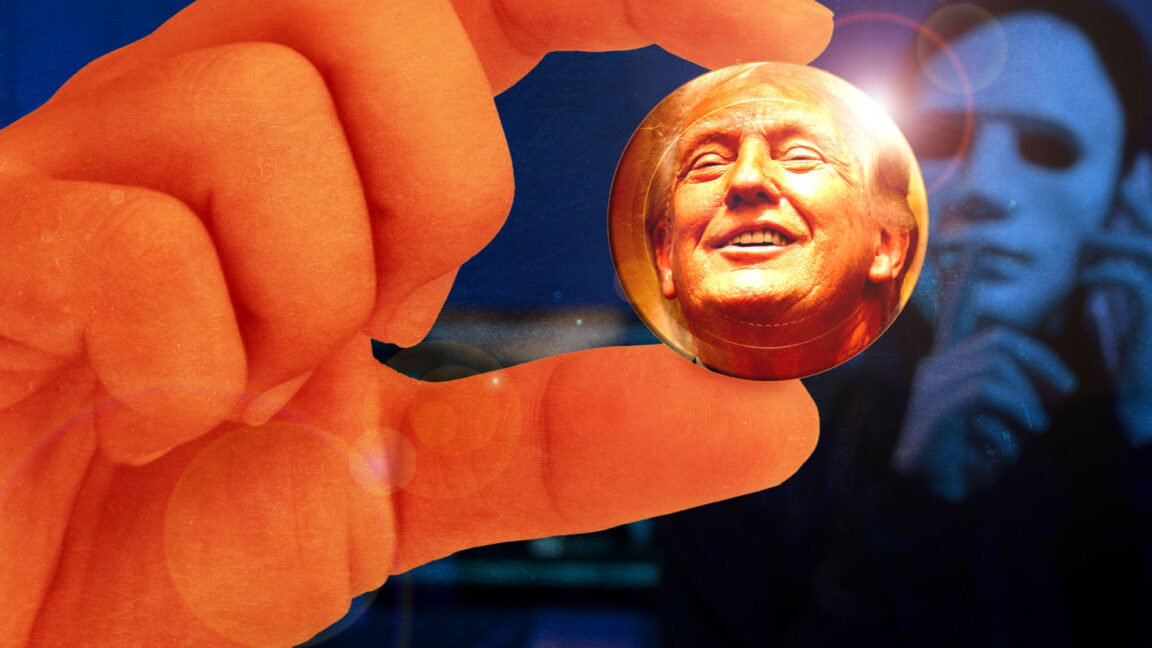
Trump launched his official memecoin before his inauguration in January 2025, becoming the first president to release his own cryptocurrency. Since then, Trump's family has reportedly made more than $280 million, while the memecoin's value has tanked.
Insiders explicitly linked to Trump affiliates who hold most of the tokens haven't been harmed; they have cashed out at key moments, collected fees on every retail trade, and earned profits exceeding $600 million. But retail investors buying into the politicized token have lost more than $4.3 billion, CryptoRank reported in a widely shared analysis.
Initially priced at $28.73, the tokens are worth substantially less today, losing about 93 percent of their value from their peak. The Melania Trump memecoin, launched at the same time, is the bigger failure, with a 99 percent loss from its peak price.
The true value for people hoarding the Trump memecoins isn't gains, though—it's the chance to score an invite to exclusive Trump-hosted events if they're among the top 200 to 300 holders.
Investors competing to buy tokens and top leaderboards have caused the price to spike twice since trading began on Solana and TRON blockchains. Last year, the announcement of a Mar-a-Lago dinner where Trump reportedly made a very brief appearance drove the price to $45.50, its highest peak. After the dinner ended, the price dropped to an all-time low of $2.71 and hasn't recovered much since. Apart from a brief 60 percent spike in price after last month's announcement of a second Mar-a-Lago event—a cryptocurrency conference and gala scheduled for April 25—the price has largely stuck under $3, where it remains as of this writing.
Ahead of the next memecoin event, the "GetTrumpMemes" X account cheered retail investors on, encouraging them to buy more tokens that could increase their chances of attending the conference and gala. Teasing photo ops with boxer Mike Tyson and a keynote speech from Trump, the posts reminded investors that it was still a "close race" to get one of the most exclusive invitations and become a top-29 VIP. Those attendees get extra perks like a seemingly more expensive watch, on top of the "Trump fragrance," trading card, and commemorative poster that everyone gets.
David Krause, a finance expert at Marquette University, has been monitoring the Trump memecoin since its launch. In March, he analyzed the impact of promotional events on the token's price. He found that not only did the upcoming gala fail to "reverse the long-term downward trend" since the first event, but the cards seem particularly stacked against investors long-term, since "approximately 80 percent of the token supply is controlled by Trump-affiliated entities" who may have no interest in the token's market value. Those entities collect fees whenever the token is traded, benefiting from surges before events and reportedly earning more than $324 million in fees alone since the memecoin launched.
"This level of concentration is highly unusual and widely considered a significant red flag," Krause told Ars.
Because insiders maintain significant control, they can prioritize potential personal gain over long-term value creation for investors, Krause said. CryptoRank reported that for every dollar insiders earned, investors lost $20, he noted.
If lawmakers don't intervene, this situation could stretch across Trump's entire term, "since developers locked $2.7 billion in insider tokens in smart contracts until 2028," Krause said.
That plan essentially established "a structured exit strategy" for insiders who can sit on their holdings, cash in when Trump promotes events, and then sell off their tokens once Trump's term ends, he suggested. That potentially leaves "underwater retail holders" stuck with depreciating assets, Krause said, and no more future dinners with the president to potentially spike the price and bail them out.
Concerned about the apparent lack of investor protection, Krause has recommended additional research into on-chain wallet activity to "determine whether insider selling accompanies promotional announcement."
In his analysis, he noted that there's also no roadmap for the Trump cryptocurrency. That isn't unusual for a memecoin, but the token's lack of utility and "heavy reliance on financial incentives" like promotional events "rather than tangible product development" is noteworthy, he said.
In lieu of a roadmap, GetTrumpMemes posted an update on X claiming that "$TRUMP is entering its next phase of development, focused on liquidity depth, additional utilities, and disciplined long-term value creation."
The post proposed "three coordinated initiatives to improve market quality and strengthen the ecosystem" that were "being implemented." Those efforts include offering rewards for participating in "Kamino vaults" that allow an algorithm to optimize trading fees, as well as a plan to unlock more tokens to pursue more "growth initiatives."
Krause told Ars that "the plans represent an attempt to pivot from pure speculation to a yield-driven ecosystem." They include "a 'Yield and Liquidity Plan' by which holders can earn $TRUMP and stablecoin rewards through the Kamino treasury, alongside institutional-grade market structure optimization and strategic inventory management."
It's the sort of plan that sounds good in an X post, Krause suggested. "However, independent analysts caution that despite these efforts, the token's price reality remains bearish, with the recent event-driven rally still down roughly 99 percent from its peak, and any long-term reversal would require the token to decouple from political news cycles and develop real utility beyond speculative incentives," Krause said.
Essentially, for retail investors to profit in the long term, achieving peak prices cannot hinge on Trump throwing a big party at Mar-a-Lago.
GetTrumpMemes did not respond to Ars' request to comment.
Robert Maguire, vice president of research for a progressive watchdog nonprofit called Citizens for Responsibility and Ethics in Washington (CREW), has also been closely watching Trump's memecoin, among other reported conflicts of interest.
He told Ars that Trump has already outpaced the conflicts of interest Maguire's group tracked during Trump's last time in office. In particular, the memecoin launch just prior to Trump's inauguration served as a clear signal that the president would be more brazen about using the office to enrich himself this term, Maguire suggested.
But Trump's crypto activity could grind to a halt as his approval ratings keep hitting new record lows. Voters are upset about his policies on tariffs, AI, and immigration. Additionally, his unliteral decisions causing escalations in the Iran War—and a dangerous threat that "a whole civilization will die" if his demands in the war weren't met—recently spurred urgent calls for his impeachment from Democrats.
As the president's popularity wanes, his memecoins may come under more scrutiny, as it's unclear who the wallet holders are and what value they're deriving from holding some of the most high-risk tokens available. Maguire told Ars there's "ample evidence" that retail investors "hope and intend to get something in return" for enriching the president, like a pardon or a business opportunity, for instance.
There's also a "foreign influence element," Maguire said, noting that "more than 70 percent of attendees" of the first memecoin event who could be identified "were foreign." Although the Trump memecoin website emphasizes that "no foreign Government Officials are allowed to attend" the upcoming event, there's no knowing whose interests could be represented by extremely large memecoin purchases of unknown foreign entities seeking to enrich Trump, Maguire said.
"So not only have we been very clearly shown that the president is acting in his own financial interests and not the national interest, but he's also acting in his own financial interest as it relates to any foreign entity that has the ability to make the kinds of payments that will catch his eye," Maguire said.
If any foreign government were found to be purchasing memecoins to influence the president, that would be a clear violation of the Foreign Emoluments Clause of the Constitution, Maguire said. The rule prevents presidents from acting against national interests by blocking federal officials from accepting gifts or profits from foreign governments.
Notably, the other cryptocurrency venture tied to Trump and his family, World Liberty Financial, has eclipsed the memecoin and enriched the Trump family by an estimated $5 billion, The Wall Street Journal reported. That venture has already sparked a Senate request for an ethics probe over a billion-dollar deal with a state-backed Emirati investment firm, MGX.
"Because MGX is so closely associated with the UAE’s government, payments made to WLF, which itself has connections to President Trump and his family, may violate the Emoluments Clause of the US Constitution," senators wrote. "The deal may also violate federal ethics statutes, including criminal provisions barring bribery. This deal raises the troubling prospect" that the Trump family and associates "could expand the use of their stablecoin as an avenue to profit from foreign corruption," they wrote.
The White House has repeatedly denied any conflicts of interest, and so far, Trump has evaded serious inquiries into his crypto dealings. This may be because the agencies that could investigate him are either understaffed following Department of Government Efficiency reductions or run by appointed officials who pledged loyalty to Trump, Maguire suggested.
"We have this situation where the president is open for business, and people are showing up and personally enriching him, and they are getting things in return," Maguire said. "And we are largely, in many ways, being left in the dark."
Should the Democrats reclaim power in the House of Representatives, Maguire thinks that even Republicans who have been hesitant to acknowledge Trump's most blatant conflicts of interest could possibly back legislation to limit his family's crypto dealings.
"I feel pretty confident that this would be a priority for a new Congress," Maguire said. "I say that with a huge sort of grain of salt because it is difficult in this era to imagine Congress actually doing something, but it is also entirely possible that this starts to gain a salience and that people start to realize it's really sort of becoming a bipartisan issue."
Last month, the Securities and Exchange Commission (SEC) narrowed securities definitions in a way that could benefit the Trump family, The Guardian reported. By classifying "most of crypto-based assets as commodities, collectibles, payment tokens or 'digital tools'" instead of securities, Trump's crypto ventures will continue to be exempt from SEC oversight and disclosure requirements that might help the public track any potential conflicts of interest.
None of that would be an issue, however, if Democrats drummed up support for two bills introduced last year that largely stalled without Republican support.
Pointedly targeting Trump's memecoin, the Modern Emoluments and Malfeasance Enforcement (MEME) Act would apply to the president and other senior officials, as well as their spouses and dependent children. If passed, they would be blocked from "benefiting from the issuance, sponsorship, or promotion of certain assets," including "digital assets such as cryptocurrency or a memecoin."
That bill requires disgorgement and imprisonment of up to five years if a violation is found. It also "provides additional penalties for such prohibited activities if they involve bribery or insider trading." When introducing the bill, Rep. Sam Liccardo (D-Calif.) called out Trump's memecoin while invoking a Richard Nixon quote: "The people have got to know whether or not their president is a crook."
"$TRUMP and the other family memecoins are as crooked as schemes come," Liccardo said.
The other bill goes even further, banning the concept of an official Trump memecoin itself. Sponsor Rep. Ritchie Torres (D-N.Y.) said that was necessary to end Trump's "blatant" memecoin corruption.
If passed, the Stop Presidential Profiteering from Digital Assets Act would make it illegal to issue, promote, or sell "digital assets that use the name, likeness, or identifiable traits of certain Federal officials or their immediate family for financial gain." Penalties include fines of up to $250,000 per violation or the amount that was gained, whichever is greater.
For Trump, who still has more than two years left in office, the consequences could come swiftly if either bill passes and ends the memecoin events, potentially causing swings in value that may only enrich Trump and his allies. The SEC would be required to implement the rules within 180 days of the legislation's passing.
Maguire thinks passing these bills should be a "no-brainer" more than a year into Trump's crypto dealings. But the political makeup of Congress during the back half of his term will likely determine if Trump ever faces investigations or consequences for any conflicts of interest exposed in his family's crypto empire.
Watching from Washington, Maguire thinks both the memecoins and the World Liberty Financial tokens are "essentially vehicles for corruption in a way that we have just never seen," and he's worried that it seems like Trump is "not trying to hide it at all."
"They both would not be as profitable as they are if they weren't attached to the president of the United States," Maguire said.
If efforts to ban Trump's memecoin are successful, or if memecoin investors realize that there are no long-term profits on the horizon, "the TRUMP token may serve as a cautionary case for the risks of speculative assets tied to political figures," Krause said.
In the meantime, loyal investors will keep buying enough memecoins to qualify for events. One social media influencer, Nicholas Pinto, bought more than $360,000 in Trump memecoins, then called the first dinner "trash," with "Walmart steak" on the menu. He told Fortune he'd be back for seconds and plans to attend the upcoming conference.
Pinto previously told Fortune that he had no access to Trump during the memecoin dinner last year, which aligns with reports that the president only briefly dropped in, raising questions about why anyone would want to attend.
It's unclear how long Trump plans to be at this year's event. Although he's a featured speaker, the Florida gala is scheduled for the same day as the White House Correspondents' Dinner in Washington, DC, which Trump has boycotted in prior years but now plans to attend. In March, a White House official granted anonymity to speak freely told Politico that the gala was not locked in on Trump's schedule. The White House did not respond to Ars' request to clarify if it's on his schedule now.
As the next event approaches, questions remain about what kinds of deals might be struck at these gatherings to potentially influence the president. But perhaps the biggest sign that there's something amiss lies in a question on the GetTrumpMemes website's FAQ.
"Is this real?" the fifth entry on the page asks.
To which the organization profiting from the first memecoin that mixed cryptocurrency markets with political figures responded, "This is 100 percent real."

Taken together, these four features can create a trancelike state that can keep us stuck on social media apps or video games for hours. Children are particularly vulnerable.
(Image credit: Paige Stampatori for NPR)


