Celebrating its fiftieth anniversary, the Hong Kong International Film Festival will open on Wednesday with Anthony Chen’s We Are All Strangers, a family drama set in contemporary Singapore that met with solid reviews when it premiered in competition in Berlin. “As flavorful and satisfying as the Hokkien noodles seen being stir-fried, seasoned, and served with a cold beer at various intervals,” wrote David Rooney in the Hollywood Reporter, “the film is a hypnotic conclusion to what the writer-director calls his Growing Up trilogy—preceded by the poignant domestic drama Ilo Ilo and the melancholic intergenerational romance Wet Season.”
The closing night film, screening on April 12, will be Philip Yung’s Cyclone, starring Yuqiao Liu as a sex worker saving up for gender-affirming surgery. “Although internationally known for multilayered crime films such as Where the Wind Blows (2022), Philip Yung has long been drawn to more intimate stories,” wrote Vanja Kaludjercic, the director of the International Film Festival Rotterdam, when the film premiered in February. “Cyclone feels like a place where everything he cares about has found a home. The narrative is both sprawling and concentrated, profoundly personal yet resonant with the experience of a people. It moves across temporal, regional, and cultural barriers with clarity and grace, all the while maintaining an effortless visual beauty.”
Along with more than two hundred films from seventy-one countries, a spotlight on Jia Zhang-Ke, and more special guests including Juliette Binoche, Ildikó Enyedi, and Ben Rivers, HKIFF50 will also present Revisiting Chinese Cinema: The Beginning of a New Journey. The lineup of twelve Chinese-language classics that the festival has championed over the years is roughly divided into three subsections focusing on the China, Hong Kong, and Taiwan. Chen Kaige, Tian Zhuangzhuang, Huang Jianxin, Ann Hui, and Tsai Ming-Liang will be on hand to deliver master classes.
Fifth Generation
With the onset of the Cultural Revolution in 1966, the Beijing Film Academy was more or less shut down and didn’t begin accepting new students again until 1978, two years after the death of Mao Zedong. The first graduating class of 1982 included future leading filmmakers of what became known as the Fifth Generation.
“Marked by radical aesthetic experimentation, boldly emotive performances, and complex and critical thinking about the events leading up to and following the 1949 Revolution,” wrote Noah Cowen for the BFI in 2014, “such celebrated films as Chen Kaige’s Yellow Earth (1984), Zhang Yimou’s Red Sorghum (1987), and Tian Zhuangzhuang’s The Horse Thief (1986) came to represent a definitive break with preceding Mainland cinema, while their dazzling play with color and striking, often symbolic use of landscape endowed them with an epic dimension that brought Chinese cinema to the forefront of the international art-house circuit.”
Yellow Earth, Chen’s debut feature, was shot by Zhang Yimou and won the top prize in Hong Kong in 1985. Set in the late 1930s, the story centers on a communist soldier sent to a remote village to gather traditional songs as artifacts of peasant culture. He wins the trust of a family with a young daughter whose marriage has already been arranged, and “he realizes helplessly that he is powerless to intervene,” wrote Tony Rayns around twenty years ago. “The film’s political candor matches its aesthetic daring. The images, exquisitely composed, derive from the traditions of Shaanxi peasant painting and Chen uses them as the basis for a film ‘language’ unlike anything else in contemporary cinema. The summit of his achievement is that he makes his new language sing.”
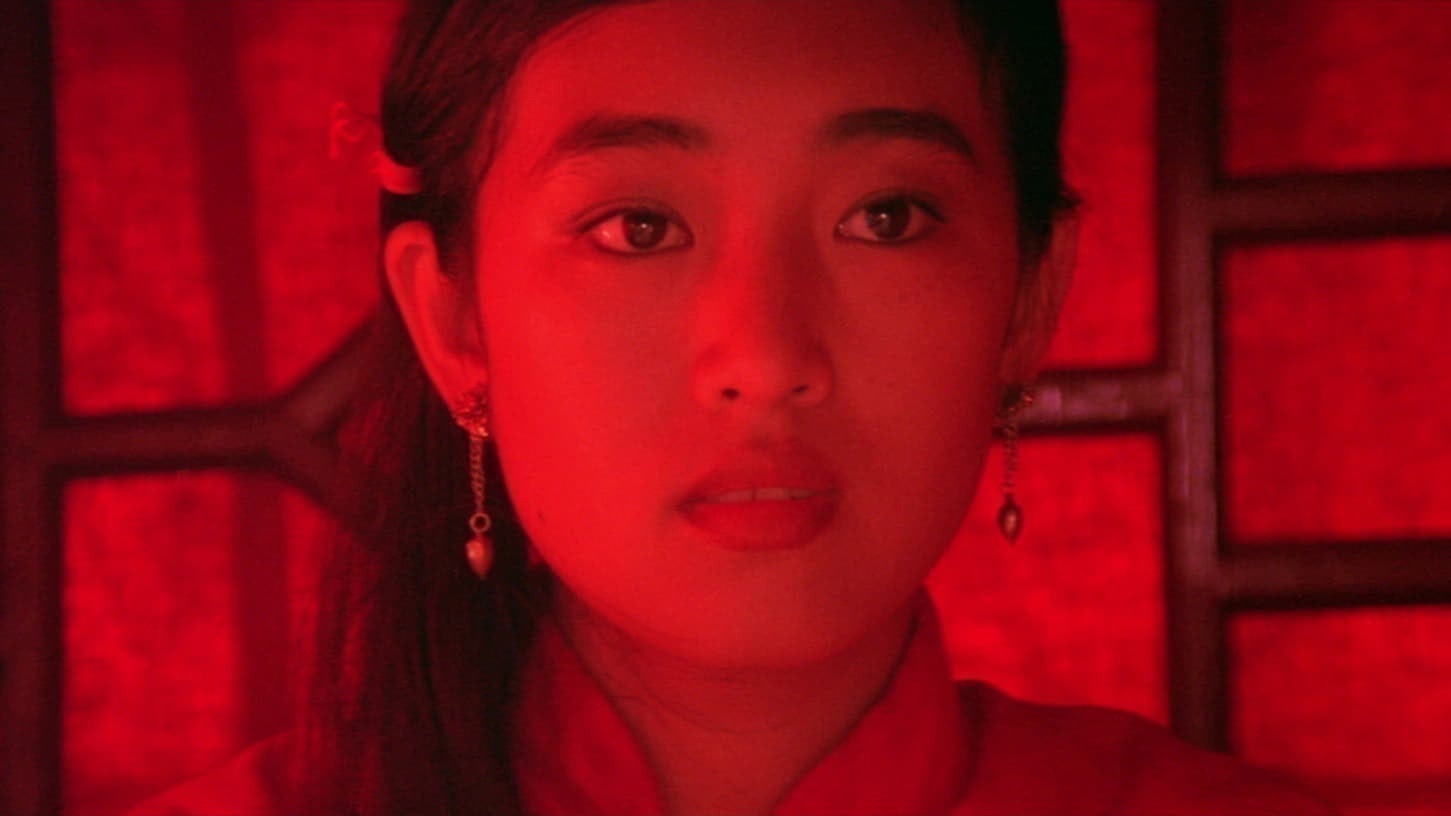
Red Sorghum, a winner of the Golden Bear in Berlin, was Zhang Yimou’s own directorial debut, and it launched Gong Li’s acting career as well. She plays Jiu’er, a young peasant sold to a sick old man who runs a wine distillery. When he dies, she takes over and rallies the workers—one of whom is murdered by the invading Japanese army as the Second World War breaks out in Asia. Jiu’er incites the workers to avenge his death.
“It ends tragically, of course. It’s also absolutely beautiful,” wrote Elizabeth Kerr when she revisited Red Sorghum in the Hollywood Reporter in 2019. “Zhang may not have invented imagery hinting at the cycle of life and death, of rebirth and renewal of both people and systems, but he certainly made it more visceral. The swaying of the sorghum field grass, blood mingling with wine, and a landscape bathed in the otherworldly light of a solar eclipse for the operatic finale announced a singular new voice.”
Set in the Tibetan mountains, Tian’s The Horse Thief centers on a tribesman torn between what he knows is right and the needs of his hungry family. “The relatively small role played by dialogue and story line and the striking uses of composition and superimposition make it evocative of certain films of the ’20s,” wrote Jonathan Rosenbaum in a 1987 review for the Chicago Review, “although it is anything but a silent film: the chants, percussion, and bells of Buddhist rituals and the beautiful musical score that incorporates them form an essential part of its texture.”
Writing for Film Comment in 2014, Grady Hendrix noted that “while Zhang, Chen, and Tian still premiere their movies at Berlin and Cannes,” Huang Jianxin remained “largely forgotten . . . Why does everyone ignore Huang? Because he’s a comedian.” In Huang’s first feature, The Black Cannon Incident (1985), a translator at a mining company is fired after sending a simple telegram that the local party chief suspects is written in some sort of code. “Dry as the desert, this was a bureaucratic farce of a type that hadn’t been seen in China for decades,” wrote Hendrix. “Two conferences to discuss Black Cannon were organized in January 1986, one by the editors of Film Art and one by the China Art Research Center, but critics couldn’t embrace how radical the movie was. Huang’s satire was too barbed, so they pretended they didn’t get it.”
Hong Kong New Wave
In his 2008 book Hong Kong New Wave Cinema (1978–2000), Pak Tong Cheuk, like most historians of the movement, divides it into two generations, and HKIFF50 will focus on the first. Tsui Hark, Ann Hui, Patrick Tam, and Allen Fong all spent time studying overseas, either in the U.S. or the UK, before returning to Hong Kong to work in television and eventually shoot their first features.
Released in the summer of 1979 and set in some fantastical distant past, Tsui’s The Butterfly Murders is a dazzling story actually sparked by poisonous killer butterflies. Tsui “cracks the chrysalis, as it were, just the mélange of wuxia combat and Gothic whodunit and vengeful-Nature horror for a freewheeling novice,” writes Fernando F. Croce.
Ann Hui’s The Secret (1979), starring Sylvia Chang and loosely based on a real-life double murder, followed a few months later. In a 2018 survey of Hui’s filmography for M+ Magazine,Long Tin wrote of The Secret that “beyond the twists, turns, and awe-inspiring narrative of the mystery genre—not to mention the various ingenious designs of characterization, setting, and mood—the true emotional power of the film lies in its keen sensitivity towards human nature and the dauntlessness with which the camera captures the darker side of the human heart.”
“By the time of The Sword’s release in 1980,” writes Jake Cole at Slant, “the wuxia genre had begun to fall out of favor in the Hong Kong in favor of kung-fu movies and more contemporary-set action films that would define the province’s genre cinema for the next two decades. In many ways, Patrick Tam’s film, with its blend of melodrama, weapons-based action, and wire-fu choreography, is a throwback to the genre’s heyday.” But Tam “complicates the story with an emotional dimension rare to even the most florid wuxia of years past.”
Allen Fong’s Ah Ying (1983) hews tightly to the life of its lead player, Hui So-ying, who splits her time between working in her parents’ fish stall and her acting classes at Hong Kong’s Film Culture Centre. For Koel Chu, writing for Notebook a few years ago, the “significance of Ah Ying lies in its embodiment of a type of realism that is marginalized in the international understanding of Hong Kong cinema, which is a very different manner of romanticization than foreign audiences are used to.”
Taiwan New Cinema
Of the three Chinese-language new waves, Taiwan’s New Cinema comes closest to having been launched intentionally. By the late 1970s, the local industry was floundering, and the Central Motion Picture Company set up a program engaging a fresh generation of filmmakers. The first project, In Our Time (1982), gathers four short films written and directed by Tao Te-chen, Edward Yang, Ko I-chen, and Chang Yi, each set in successive decades from the 1950s through the 1980s.
In Our Time “works perfectly as a defining opening statement by a new generation of filmmakers,” writes Sean Gilman for Notebook. “Yang is the most successful of the directors, so his short will draw the most attention, and deservedly so. His patience with the narrative and attention to the smallest details of setting and performance stand out from the other, more conventional films.”
Wan Jen’s Ah Fei (1983), based on the novel by Liao Hui-Ying, who cowrote the screenplay with Hou Hsiao-hsien, “depicts the severe gender inequality and hardships women once silently endured, bitterly resigned to their fate and passing on the trauma to their daughters,” wrote Han Cheung in the Taipei Times when a new restoration was released in 2023. Hou’s own Dust in the Wind (1986) stars Wang Chien-wen as Wan, described by Andrew Tracy at Reverse Shot in 2008 as “a quiet intellectual-in-the-making patterned after the film’s cowriter Wu Nien-jen (the screenwriter/director/actor fondly remembered as NJ in Edward Yang’s Yi Yi).”
Wan and his girlfriend Huen (Xin Shufen) leave their rural coal-mining town for Taipei, where they contend with a myriad of challenges together until Wan is called to serve his time in the military. “The vastness of the onscreen world and the reticence of the narrative elevate the film’s emotion to a more crystalline level,” wrote Tracy. “We are moved not immediately, but cumulatively, with the full weight of what each individual pain articulates.”
Tsai Ming-liang’s first feature, Rebels of the Neon God (1992), stars—as all of his subsequent features would—Lee Kang-sheng, here in his early twenties and one of four roustabouts bopping from video arcade to café to love hotel in contemporary Taipei. “Listlessness abounds in an atmosphere of sodden fluorescence,” wrote Jonathan Kiefer in the Village Voice in 2015, “with even the most built-up environments apparently defenseless against water pouring from the sky or oozing from the ground, but Tsai never seems pompous. Rebels of the Neon God inaugurates the filmmaker’s multi-movie study of urban alienation not with showoff chops but quiet, enduring compassion.”
Don’t miss out on your Daily briefing! Subscribe to the RSS feed.
The F-14 was made famous in Top Gun. The U.S. sold the planes to Iran in the 1970s, only for the two countries to become enemies. Iran kept its F-14s flying for decades in the face of U.S. sanctions.
The Division 9 Maximum Security Dormitory of the Cook County Department of Corrections — where inmates have been found using deadly illicit drugs — saturated onto paper — in the pages of books, letters from family and legal documents.
Canadian soldiers transported M777 howitzers to the High Arctic to show their ability to fight in an increasingly contested part of the world. It did not go as planned.
 Log in