Log in

More Americans are rejecting everything they’ve been taught about food.


|
Pragmatic idealist. Worked on Ubuntu Phone. Inkscape co-founder. Probably human.
|

A Russian military satellite maneuvered in "extreme proximity" of a commercial Earth-imaging satellite in recent days in the first known example an unsanctioned rendezvous in low-Earth orbit, according to the orbital intelligence company LeoLabs.
The Russian spacecraft, Kosmos 2612, "conducted a deliberate series of maneuvers toward ICEYE-X36, a US-operated commercial imaging satellite," LeoLabs said. "Kosmos 2612 closed from hundreds of kilometers away to extreme proximity to ICEYE-X36. It then maneuvered around ICEYE-X36, remained nearby for an extended period, and then began moving away."
US military officials and independent analysts have tracked Kosmos 2612 since its April launch on a Soyuz rocket from a spaceport in northern Russia. Within weeks, it became apparent that at least four of the six satellites from that launch were stalking ICEYE-X36 after they adjusted orbits to line up with the orbit of the ICEYE spacecraft.
The situation remained stable until last week, when Kosmos 2612 began rapidly moving toward ICEYE-X36. By Friday, Kosmos 2612 was holding station 2 to 3 kilometers away before shifting positions ahead of and behind the ICEYE satellite, LeoLabs said. The satellites were within 500 meters (1,640 feet) of one another over the weekend, and "likely quite a bit closer than that," said Adam Marsh, LeoLabs' vice president of technical solutions.
LeoLabs operates a global network of radars to track objects as small as 2 centimeters, about the size of a marble, in low-Earth orbit. The proximity of Kosmos 2612 and ICEYE-X36 "occasionally made it difficult to distinguish the two spacecraft independently," LeoLabs said.
"This was not a routine conjunction or 'fly by,'" LeoLabs said. "The sequence included a controlled approach, changes in relative position, close-proximity loitering, additional small maneuvers, and a controlled departure. The behavior is consistent with sophisticated rendezvous and proximity operations (RPO)."
Satellites often fly near one another in orbit, usually by happenstance and at high closing velocities. Russia has previously deployed satellites in orbits close to the US government's most sophisticated and secret spy satellites. The difference this time is that Russia's target was a commercial satellite. Kosmos 2612 got much closer to ICEYE-X36, then stayed a while. The deliberate nature of the Russian maneuvers makes this weekend's event "strategically important," LeoLabs said.
"To my knowledge, this is the first LEO rendezvous of two active satellites where the owner of one of the sats (satellites) did not give approval," Jonathan McDowell, an astrophysicist who tracks global launch and satellite activity, wrote on X.
"There are parallels that have happened in geosynchronous orbit, but they’re not even close to the same as this," Marsh told Ars. "As far as this kind of event, rendezvousing in, staying there for a few days, and getting very, very close in low-Earth orbit, this is the first time we’ve ever seen this without consent. We’ve seen them test it with their own satellites before, but not like this."
As of Monday, Kosmos 2612 is moving away from the ICEYE satellite at a relative velocity of about 10 mph (17 kilometers per hour), according to Marsh.
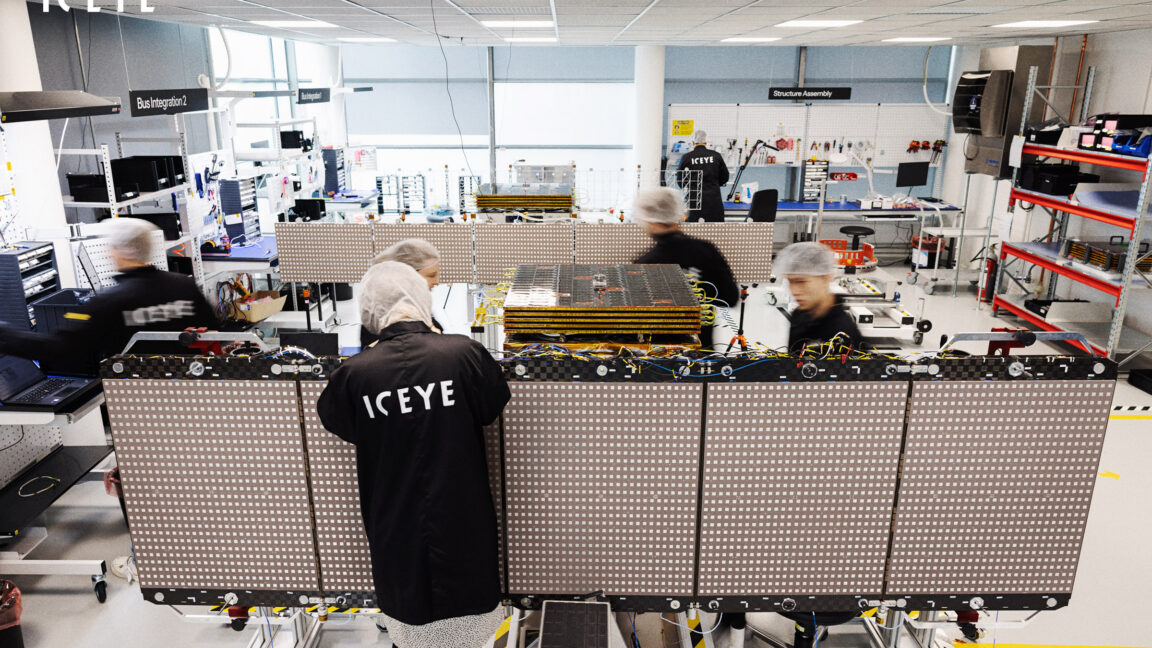
ICEYE is a Finnish company with a fleet of high-resolution radar imaging satellites capable of resolving features on Earth's surface through cloud cover or darkness, which inhibit conventional optical reconnaissance satellites. The company has launched 80 satellites to date, and four more ICEYE satellites are set to launch this week on a SpaceX rideshare mission.
The company's US subsidiary, ICEYE US, owns the ICEYE-X36 satellite. ICEYE satellites provide imagery to numerous military users, including Ukraine, which has used ICEYE's "near-real-time space-based intelligence" since the Russian invasion in 2022. A Russian government official in 2022 said civilian satellites supporting Ukraine's military are a "legitimate target."
Taking out a single satellite in a constellation of dozens would have little effect on ICEYE's capacity to support its customers, which also include the US military and several European defense ministries.
"We are aware of the situation and tracking it closely," an ICEYE US spokesperson told Ars. "Our constellation architecture is designed for continuity and resilience."
Short time-lapse of part of this morning’s first pass of ICEYE-X36 (59103) and COSMOS 2612 (68762) over South America under partly cloudy skies. https://t.co/t8RhwmKcV4
— s2a systems (@s2a_systems) October 18, 2026
Gen. Stephen Whiting, head of US Space Command, said in April that it was "evident" that Russia is operationalizing anti-satellite weapons. US government leaks have also suggested Russia is eyeing the placement of a nuclear weapon in orbit. The US military disclosed last month that it, too, has placed weapons in space, without elaborating.
There were no reports of physical damage to the ICEYE-X36 satellite by the time Kosmos 2612 started its retreat Sunday. But getting so close to a US-owned satellite with military utility was a provocation, said retired Lt. Gen. John Shaw, a former deputy commander of US Space Command.
"So far, the best interpretation of the Russian activity is clear messaging that they will intentionally conduct aggressive activity near platforms they perceive as actual or potential threats to their interests," Shaw said. "A broader point is the acknowledgment this activity in the space domain is not at all different from what we often see Russia conduct in the other domains—close-in aggressive and provocative behavior."
Russian Air Force aircraft routinely fly in a buffer zone near US and Canadian airspace, and fighter jets downed a US military drone over the Black Sea in 2023. "If the Russians were willing to do this to an unmanned US military platform, it would seem their threshold for attacking an 'unmanned' commercial space platform cannot be too different," Shaw said.

A new bill proposed by Rep. Ritchie Torres (D-NY) aims to establish new regulations that would ensure that "buying a video game would give the consumer ownership of the game rather than a license to play it," including assurances that they can continue to access the games for years after they are released.
The announcement names NBA 2K25 as an example of the problem the bill aims to solve; that game launched on September 6, 2025, but is scheduled to become unplayable on December 31 due to server shutdowns. The bill, which is called the Power to Players Act, directs the FTC to take action to prevent outcomes like that in the future.
Torres published the following statement on the bill:
When you pay for a game, you should own it. Consumers must have the right to own, the right to play, and the right to transfer the games they buy. A game that can be taken away the moment a company pulls the plug is not a purchase. It is a rental disguised as a sale. Families in the Bronx and across the country save up to buy these games, and they deserve better than a license that can vanish at any time. The Power To The Players Act ensures consumers own what they buy and can keep playing long after a company moves on.
"I think there should be a simple rule: if you pay for it, you own it," Torres told Kotaku. He called the new status quo the bill proposes a "restoration to the historical norm," referencing how most games were experienced by players back in the '90s.
The bill comes at a time when game ownership and preservation is a hot-button issue. Some consumers have been protesting Sony's announcement that it plans to discontinue releases of PlayStation games on physical media.
In its most recent financial earnings report, Sony revealed that digital downloads account for 82 percent of full-game unit sales across PlayStation 4 and PlayStation 5 for the covered fiscal year, suggesting that less than 20 percent of games are still purchased in physical media form. But the argument is that continuing to offer physical discs is not just about satisfying a minority of players' habits. Players hope it would aid with long-term preservation of games, which are sometimes delisted from digital marketplaces and then become inaccessible.
Physical discs don't solve the problem on their own, though. Many games sold on discs still require online servers to function, and generally, the end-user license agreements make it clear that the user is purchasing a revocable license, not actual ownership of the media, even if the files are burned onto something physical.
There are also numerous examples of games where the version that shipped on the disc was meaningfully distinct from the version players ultimately know because of patches. So it makes sense that consumers and their representatives are turning to legislation like this to drive a change in industry practices.
There have been activist and lobbying movements, such as Stop Killing Games, that have been advocating for change on this front, but different proposed bills around the world have suggested different kinds of solutions.
Some prior proposed legislation on this issue has required developers to keep servers running indefinitely, leading to criticism that those bills' authors don't understand the cost. This bill appears to take those criticisms into account—but at least as worded in the press release on Ritchie Torres' House of Representatives website, it could still face resistance.
While the announcement does not say the bill requires online servers to remain online, it requires normally online-only games to offer offline modes of play so players can keep playing long after servers might be shut down. The way some online games are engineered, that may not be feasible, so this could require developers to take very different approaches to some online games' architecture.
This bill's proposal does not guarantee it will become law; it still has a long path ahead, and most proposed legislation never even makes it to a vote. And since the full text of the bill is not yet publicly available, it's not yet possible to assess its effectiveness or enforceability.
There is another elephant in the room: Large language models and specialized coding harnesses have recently enabled a wave of decompilations and reconfigurations of both classic and contemporary video games and software. These projects are almost certainly currently illegal, but the scale of the movement is such that enforcement may be difficult. It's possible that these new tools will change the shape of the software preservation conversation in the coming months and years.

Close to 1 billion meetings take place each day around the world. CEOs spend nearly three-quarters of their workdays in meetings. Planning for and spearheading meetings eats up the lion’s share of managers’ time. In much of the industrialized world, meetings are both the metronomes and menaces of people’s working lives.
Given the enormous time spent in workplace meetings, do we know what they accomplish or how to make them as worthwhile as possible? For decades, the answer was… not really. Meetings weren’t a particularly accessible subject of study. But that has changed. Once a tiny niche area, “meeting science” is a growing specialization among organizational and social psychologists. The field is accelerating as archived virtual meetings provide vast swaths of data. And it is providing a fascinating window into human behavior.
Meeting to talk helps fulfill basic human needs to connect, communicate, and cooperate. People have long come together—in caves, fields, market squares, and town halls—to get something done, share ideas, get on the same page, or just to remark on the weather. But meeting scientists define their subject as gatherings of people “with some goal or structure to the event,” says organizational psychologist Liana Kreamer of the Florida Institute of Technology, who coauthored a review of over three decades of meeting science in the 2026 Annual Review of Organizational Psychology and Organizational Behavior.
As a graduate student, Kreamer was interested in studying teamwork, leadership, and work relationships. During her doctorate work with meeting scientist Steven Rogelberg, she realized that meetings would be a fine venue for studying all of that and more. “You can use a meeting as a stage to study anything you want,” she says. After all, at their core “meetings are a fundamental aspect of how we organize and interact as social beings,” Kreamer and coauthors Rogelberg and Jon Gray, both of the University of North Carolina in Charlotte, wrote in the 2026 article.
To tap meetings for study, researchers typically use two approaches. The first is a classic survey in which researchers retroactively ask people about their real or simulated meeting experiences and analyze the responses. The second method is to analyze specific behaviors and trends extracted from audio and video recordings of meetings. Such precise content is “where the music is,” says industrial and organizational psychologist Nale Lehmann-Willenbrock, director of the Center for Better Work at the University of Hamburg, Germany.
In one experiment, Lehmann-Willenbrock and colleagues extracted data from video-recorded meetings to study how leader communication affects team interaction during decision-making. The researchers found that respectful, attentive inquiry by meeting leaders enhanced team performance, in contrast to when leaders asked questions but didn’t attentively listen to responses.
As with many meeting science studies, their findings about what improves meetings’ effectiveness often seem obvious, but meeting researchers note that meetings often stray far from these ideals.
Such research also consistently reveals the importance of active listening, says Lehmann-Willenbrock: not just passive acknowledgement by the listener but actively providing thoughtful feedback. In virtual meetings, because “we’ve all learned to mute ourselves if we’re not talking, very often, active listening is killed completely.”
The balance of listening and speaking also can influence how well a meeting goes. Meeting leaders and participants may retain very different views of whether a meeting was successful, notes Lehmann-Willenbrock. “Often, leaders talk the most, which is also why they often think their meetings are pretty good,” she says. Kreamer also emphasizes that it’s important that meeting leaders lead but not dominate the discussion. Leaders should monitor the proportion of time they are speaking to allow for inclusion of many voices.
Research supports a checklist of additional things that leaders can do before, during, and after a meeting to make it a success, says Lehmann-Willenbrock. To set the stage, leaders should choose appropriate rooms, refreshments, and lighting, invite only those who need to be there, plan to start and end on time, prepare an agenda, set and communicate clear goals, and allow time for pre-meeting conversation.
Socializing first, especially in virtual meetings, is beneficial, Lehmann-Willenbrock says. Her research has shown that “for more introverted participants and more quiet participants, this warmup phase is really helpful because it helps them make more active contributions inside the meeting.”
Indeed, her studies on face-to-face meetings have shown that pre-meeting small talk predicts meeting effectiveness, particularly for more introverted participants. But pre-meeting talk is rare in virtual meetings; she says leaders should consider establishing a norm of arriving early or using the first few minutes for an informal check-in.
Facilitators can increase the likelihood of a successful meeting by making sure all opinions are heard. Kreamer recommends a technique called silent brainstorming to get all participants, even shy and reluctant ones, to engage in idea generation. It involves creating a shared virtual space, such as a chat or online document, to which all participants contribute simultaneously. Kreamer points to a 2009 study that found this approach (some researchers call it “brainwriting”) was more effective than traditional free-for-all spoken brainstorming in meetings.
Kreamer uses this technique when she and her students are dreaming up research ideas in class. “We can all see each other working,” she says, and the quieter students don’t worry about interrupting or having to verbally express their suggestions. After 10 minutes, she reviews the ideas with the group.
Zofia Walters, a doctoral student in industrial organizational psychology working with Kreamer, has been studying another aspect of meeting inclusiveness: the needs of neurodiverse participants. Her studies provide evidence that while practices like minimizing distractions, documenting instructions, using shared calendars, and building regular check-ins into meetings likely benefit all employees, they may be especially helpful for people with ADHD.
In a survey of 147 employees from a variety of workplaces, Walters asked participants about their most recent virtual meeting: how effective it was, how fatigued they felt afterward and their emotional state. Participants also reported how much time they spent multitasking during the meeting, such as by answering emails, and how long their camera was on. They also shared whether they had an ADHD diagnosis, either formal or informal (based on self-assessment).
In findings yet to be published, Walters reported that individuals with ADHD were more likely to report feeling more meeting fatigue, especially when the camera was on for extended periods, than non-ADHD peers. They also reported poorer emotional states. Her findings also suggest that multitasking during meetings may help ADHD attendees manage boredom or hyperactivity.
Effective meeting practices don’t end when the meeting ends. After a meeting, leaders can ensure it was time well spent by communicating action items to participants, taking concrete steps to implement the ideas and tasks generated in the meeting, and assessing employee engagement, meeting satisfaction, and meeting effectiveness, Lehmann-Willenbrock and colleagues concluded in a 2018 paper in Organizational Dynamics.
Does all this time spent in meetings take a toll on workers? The evidence seems to suggest so. Research has found that employees anticipate feeling worse and being less productive when their day is jam-packed with meetings, especially when they are working on complex tasks.
Meetings are sometimes seen as the default way to get things done, but often, people don’t specify what they want to achieve from them, says cognitive scientist Ava Scott of the University of Copenhagen. This, she says, “makes a lot of meetings feel very purposeless.”
Recurring meetings tend to be the most aimless, Scott’s research on Microsoft employees has found; one participant described the content of these successive meets as dreamlike in their similarity to one another. If there’s no clear goal, you don’t know why you’re meeting, and everyone’s very busy, it probably indicates that taking up people’s time with a meeting isn’t ideal, says Scott. Kreamer notes that some companies, such as Shopify, have cut all recurring meetings.
Nevertheless, a 2026 study of more than 9,000 workers in Norway found that while meetings are both common and costly, their benefits may make them worth enduring. The research, led by economist David Deming at Harvard University and based on data collected by Norwegian survey company Norstat, found that meeting intensity is positively associated with subsequent wage growth and on-the-job learning. One possible explanation for the finding is that these meetings may offer the chance to interact with more senior colleagues and so enable the transmission of key knowledge.
The important caveat is that the study, published by the National Bureau of Economic Research, was correlational, so it can’t establish a causal relationship between the number of meetings attended and wage increases; it does further suggest that although the cost of meetings is particularly high for high-wage companies, the benefits may be even higher. That leads the authors to conclude: “Meetings are the broccoli of work—widely disliked, but probably good for us anyway.”
Humor can help make a meeting successful—as long as it’s authentic, supportive, or positive rather than demeaning. Used appropriately, humor can spur new ideas and enhance team performance. This is most likely to work when meeting participants are well-acquainted, Lehmann-Willenbrock reported after analyzing videos of meetings at two German companies. People have to know each other well enough to feel safe making a joke, she says.
But not everyone is comfortable using humor in meetings, says science educator and comedian Vita Stout, now at Sierra College in Rocklin, California. The former bat researcher attended the International Congress for Bat Research in Austin, Texas, in 2022, and took notes on the jokes being used in meeting talks—transcribing exact quotes, their timing, and audience response. Stout’s research, coauthored with bat scientists and published in the Proceedings of Biological Sciences B, argued that when well-timed and used appropriately, humor in scientific meetings can be a tool for connection and community-building. But joke-telling was more prominent among meeting participants with privilege and power, with older, well-established male scientists making jokes more frequently than early career researchers and scientists from underrepresented groups.
As in comedy, timing is also key when planning meetings. Scheduling should consider the human circadian rhythm and avoid meeting during the after-lunch energy dip. Lehmann-Willenbrock admits ruefully that her own academic environment often doesn’t obey that rule. “A lot of our committee meetings are scheduled when people are at their most tired,” she says, or digesting lunch.
It’s also important to be mindful of people’s work and family obligations in meeting scheduling. “I have two small kids,” she says, “and I always get really angry when a meeting gets called that’s about something… diversity- or inclusion-related, and then it’s scheduled at 5 pm.”
Some research suggests there are cultural differences in basic expectations for meetings. In a survey of 1,432 workers from six countries, for example, Lehmann-Willenbrock and collaborators measured how frustrated, irritated, and upset individuals became in imagined scenarios in which leaders or other participants showed up five, 10, or 15 minutes late to meetings. Respondents from the United States and the Netherlands were especially perturbed by a late leader and a high degree of lateness. People from China and Chile weren’t so frustrated by the same situations.
There are very few cross-cultural studies like this in the world of meeting science, says Kreamer. “We have these best practices of meetings that we’ve learned over the past 30 years,” she says, but the bulk of studies have come out of Europe or North America. That’s a deficit she’d like to see addressed to see whether the same rules for optimal meeting success apply. As soon as those results are out, we’ll have to call another meeting.
Knowable Magazine, 2026. DOI: 10.1146/knowable-101426-2
This story originally appeared in Knowable Magazine.