 Log in

The World Artificial Intelligence Conference in Shanghai in July. China and the United States are locked in an A.I. race that both sides see as decisive to gaining the upper hand militarily, technologically and economically.


|
Pragmatic idealist. Worked on Ubuntu Phone. Inkscape co-founder. Probably human.
|

NASA must be more selective in the way it forges international partnerships as the race to the Moon transforms from a battle for national prestige between the United States and China into a high-stakes competition for extraterrestrial real estate and resources, the agency's administrator said.
Jared Isaacman, now in his 10th month at the helm of the world's largest civilian space agency, told a gathering of military leaders and defense contractors last week near Washington, DC, that the 21st-century race to the Moon is more than a battle of ideologies. The sweet spot for a Moon base, Isaacman said, is a relatively small region near the lunar south pole, and there are tangible implications for who gets there first.
The Moon's south pole harbors substantial quantities of water ice concentrated on the floors of craters away from the reach of sublimating rays of sunlight. The ice inside these eternally dark craters could be used to supply water, air, and rocket fuel for a Moon base, supporting a permanent settlement and providing a springboard for future expeditions to Mars.
"It's a big Moon, with the surface area of Africa," Isaacman said Wednesday at the Air & Space Forces Association's Air, Space & Cyber Conference. "The south pole is more akin to Washington, DC, when there are only so many roads and so many good parking spots that you're going to want to occupy."
The best parking spots aren't just those close to the Moon's water ice bound up in deep craters. A few select crater ridges extending high above the ice deposits provide access to near-continuous sunlight for power generation.
"We want to go there to master the skills for Mars," Isaacman said. "And when you realize there are only limited parking spots that get us access to that training environment, it creates an urgency, and we must [go fast] because the Chinese are going to the exact same locations. They are partnered with the Russians. They are going to put a nuclear reactor there, and they could potentially deny this training environment that is a necessity for America's space ambitions."
Isaacman said this means NASA must make better decisions on when and how to work with international partners. Other nations have a place in NASA's programs, but only if they can meaningfully contribute to the mission, he said.
"I will tell you, though, and this is right from the top from the president of the United States: We're only doing good deals, and we haven't always done good deals," Isaacman said. "There was absolutely a time where we were trying [to] make everyone happy. Let's get a lot of flags together for a great press release, and it can [be], and absolutely has been, at times, a drag on the mission instead of accelerating it. You can't do that, and we've changed that now, and as a result, good deals are happening."
 The rim crest and upper part of the rim of Shackleton Crater, as viewed by NASA's Lunar Reconnaissance Orbiter. The Moon's south pole is located on the rim near the upper-right corner of the image.
Credit:
NASA/GSFC/Arizona State University
The rim crest and upper part of the rim of Shackleton Crater, as viewed by NASA's Lunar Reconnaissance Orbiter. The Moon's south pole is located on the rim near the upper-right corner of the image.
Credit:
NASA/GSFC/Arizona State University
Isaacman singled out as a good deal NASA's agreement with the Italian government in March for the development of living quarters for astronauts on the Moon.
"They're committing over $5 billion to building one of the first habitation modules," Isaacman said. "It likely will be the first real habitation module that makes its way to the lunar surface. And as a result, you're going to see two Italian astronauts on the surface of the Moon."
Japan, too, is coming in clutch for NASA, Isaacman said, with a multibillion-dollar commitment to develop a pressurized rover to ferry astronauts across the Moon. In exchange, Japan will likewise get two tickets to the Moon for the country's astronauts. The US and Japanese governments signed the agreement on the pressurized rover in 2024.
"That is the expectation we set for everyone," Isaacman said. "You're not just going to bring us a list and say, 'I will do this regardless if it helps the mission or competes with US industry and what US industry is trying to accomplish on the Moon.' That is not going to work. We need meaningful contributions now. The game has changed."
The role of the European Space Agency, perhaps NASA's most enduring international partner, on the Moon Base program remains undefined. ESA signed up to provide elements for a habitation module, a refueling module, and deep space communications hardware for the planned Gateway mini-space station in orbit around the Moon.
NASA announced the cancellation of Gateway in March in a strategic shift to focus on a permanent presence on the lunar surface, where China has set its sights. It didn't help that Gateway's first pressurized module was corroded.
Canada, too, is weighing its potential contribution to the Moon Base program. The Canadian Space Agency was on the hook to build a robotic arm for the Gateway outpost, improving on the Canadian robotics systems used on the Space Shuttle and the International Space Station. The design and use case for a robotic arm on the surface of the Moon, where it must operate in partial gravity, is different from that in microgravity. It doesn't help that the Trump administration is currently engaged in a trade war with Canada, erecting a hurdle for any potential bilateral agreements.
ESA and Canada received guarantees from NASA for lunar flight opportunities for their astronauts through their agreements on Gateway. ESA also provides service modules for NASA's Orion spacecraft, the ship that carries astronauts between the Earth and the Moon. Canadian astronaut Jeremy Hansen took Canada's first seat on an Artemis mission with the flight of Artemis II around the Moon earlier this year.
NASA announced in June that ESA astronaut Luca Parmitano, a colonel in the Italian Air Force, will serve as pilot on the Artemis III mission to test lunar landers and the Orion spacecraft in low-Earth orbit in 2027.
ESA's director general, Josef Aschbacher, told reporters in June that he is eager to secure seats for the agency's astronaut corps to land on the Moon. A "meaningful" contribution to the Moon Base program would pay the fare, but it hasn't been easy to find agreement on what that might look like.
NASA's agreement with Italy, an ESA member state, was directly negotiated between the two countries outside the halls of ESA. The European Space Agency has 23 member states, which provide funding in three-year increments, offering a modicum of stability for ESA's programs at the expense of agility.
Italy's commitment to build a habitation module and Japan's contribution of a pressurized rover offer something new to NASA, which didn't have contracts with US companies to do that work. Those are the kinds of partnerships Isaacman said he is looking for.
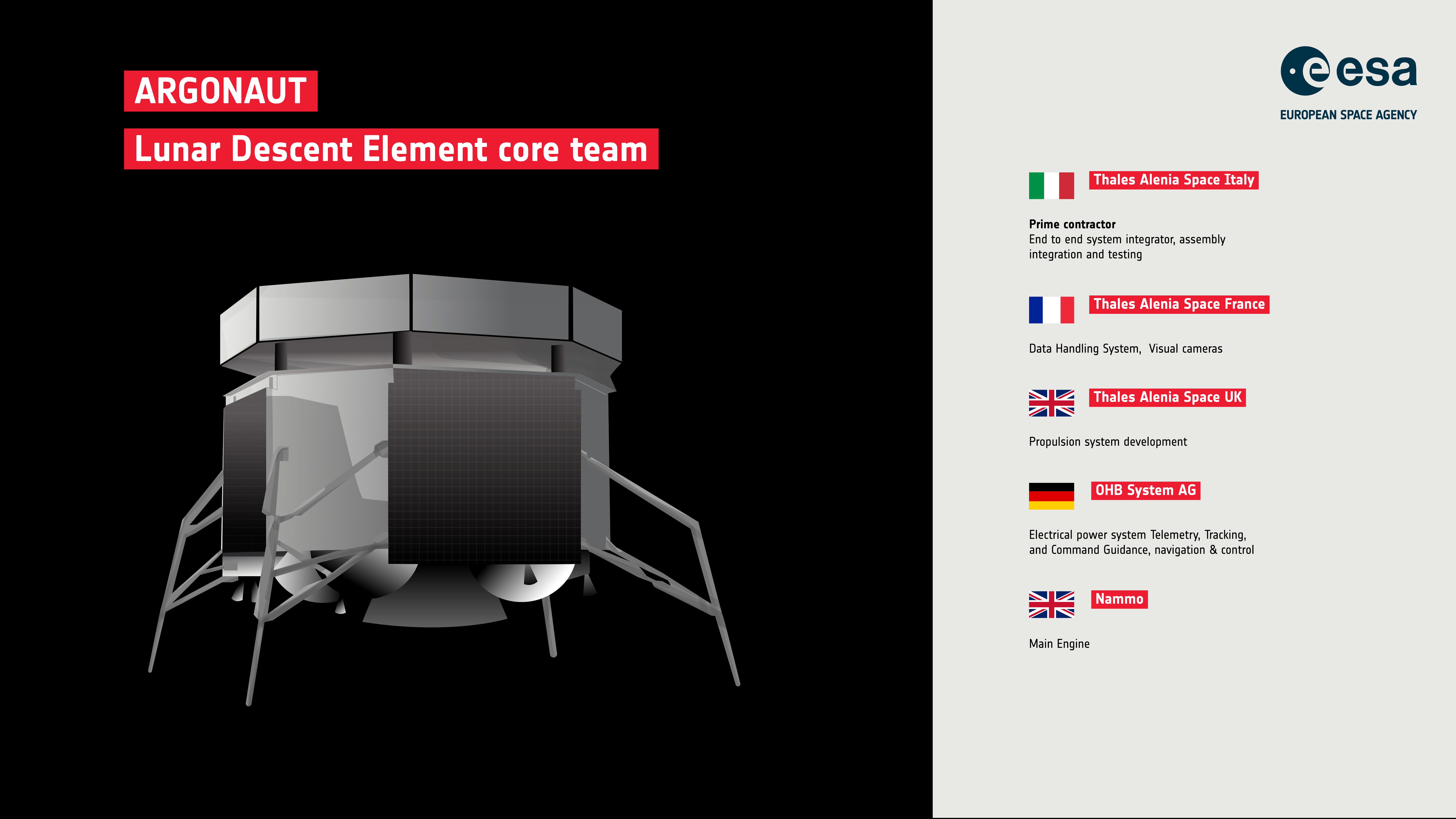 ESA's Argonaut would include elements from across Europe.
Credit:
European Space Agency
ESA's Argonaut would include elements from across Europe.
Credit:
European Space Agency
"We had one partner that said, 'Look, I'll give you a lander, a robotic lander, that'll go to Shackleton Crater by the mid-2030s," Isaacman said in a question-and-answer session at the Air, Space & Cyber Conference last week. "I was like, 'The Chinese are launching there in two months (with Chang'e 7, a mission now delayed to early 2027). What good is that to us then? There will be no landing spots available at that point in time.'"
Isaacman did not identify which partner he was talking about, but it almost certainly was ESA, which is seeking a role for its Argonaut cargo lander in NASA's Moon Base program. The problem from NASA's perspective is that Argonaut would replicate much of what US companies are well along in developing.
Each Argonaut lander could deliver to the lunar surface up to 1.5 metric tons (3,300 pounds) of cargo, such as crew provisions, science instruments, and infrastructure, according to ESA. That is half of the payload capacity of Blue Origin's Blue Moon Mark 1 lander, set to make its first flight to the Shackleton Connecting Ridge near the Moon's south pole next year and far below the cargo capability of larger human-rated landers like Blue Moon Mark 2 or SpaceX's Starship.
"We've got to get in touch with reality and make meaningful contributions to what NASA and the free world are trying to achieve with our space ambitions," Isaacman said.


In 2022, American dominance in AI looked almost unassailable. The U.S. led in advanced models, semiconductors, capital and talent. Its closest competitor, China, appeared to be reeling from export controls that cut it off from the world’s most advanced process nodes, chips and memory technologies.
Four years later, the tide seems to be turning. Chinese models have gained major global token share; American technology giants are eyeing Chinese logic and memory chips; and America’s grand AI ambitions face growing public backlash.
During the first three months of 2026, local opposition blocked or delayed roughly $130 billion in data center projects. This spring, 71% of Americans surveyed opposed the construction of a data center near where they live. Texas, the fastest-growing state in data center construction, has frozen new grid-connected projects until further impact studies are completed. Data centers have become a bipartisan sleeper issue for the election cycle.

In the final weeks of 2019, a top fundraiser for Sen. Susan Collins walked into a perilous meeting at a Corner Bakery in Washington, D.C.
For the first time in her two-decade Senate career, the Republican lawmaker from Maine was in danger of losing her seat. President Donald Trump’s dismal approval ratings were dragging her down in the polls, and she was falling behind her likely 2020 Democratic challenger in fundraising.
Scott Reed, head of the Collins super PAC, was on a mission to close that gap. Reed was meeting that day with three executives from a Hawaiian defense contractor, Navatek. A year earlier, Collins had helped their company land a multimillion-dollar Navy research contract in Maine. Now, seated at a coffee shop not far from the U.S. Capitol, Reed asked them for a $500,000 donation.
Government contractors are banned from making political contributions. More consequentially, for the company to offer donations to Collins in exchange for an official action, or for Collins to accept, would constitute criminal bribery.
But the company did have such a proposal: Navatek was hungry for more government contracts in Maine. If they cut a big check, the CEO told Reed, Navatek wanted Collins to guarantee tens of millions of dollars in additional federal funding.
To skirt campaign finance laws and conceal the source of the funds, Navatek planned to funnel the donation through a shell company. The CEO wanted assurance that Collins would know where the money came from. Reed confirmed that she would, the executive said — and that Navatek would get its government contracts.
After the Corner Bakery meeting, Navatek’s CEO, Martin Kao, sent an initial $150,000 to the Collins super PAC using the shell company. Two months later, he told Navatek executives that Collins committed to getting the company $32 million in naval contracts, according to an internal company email reviewed by ProPublica.
Three years later, Kao holed up in a conference room to recount the Corner Bakery meeting to a group of four FBI agents and federal prosecutors. The FBI had seen through his shell company ruse, and in 2022 a grand jury indicted him for making illegal campaign contributions. No one working for Collins was charged.
Facing years in prison, Kao hoped to do less time by revealing the entire scheme.
What he told them has never before become public. The Corner Bakery meeting, he asserted, was just one episode in a sprawling pay-to-play operation that embroiled some of the most powerful figures in Congress.
Over three days at the U.S. attorney’s office in Honolulu, Kao laid out in devastating detail how his operation worked. He gave agents a 50-page document naming dozens of lobbyists, congressional staffers and members of Congress who he said helped him trade cash for contracts. Kao and his close associates had donated nearly $900,000 to dozens of politicians, allowing Navatek to establish operations in half a dozen states with over $40 million a year in government funding.
We’re still reporting on pay-for-play arrangements between powerful companies and elected officials.
William Turton
I want to hear from you. Please feel free to send tips or story ideas. The best way to reach me is on Signal at 804-295-7201.
Most damningly, Kao told FBI agents and prosecutors, the company’s work for the government was of no real value. Navatek’s research under his stewardship never resulted in products the military wanted to buy, ProPublica found.
Kao’s tell-all interviews with the FBI lasted into late 2024. His confessions opened up an entirely new phase of the investigation. Agents sifted through hundreds of thousands of records seized during Kao’s arrest and found that many were consistent with his account of widespread influence peddling.
Kao had credibility issues. He was now a felon trying to avoid a lengthy prison sentence. And there were other challenges. Building a corruption case against elected officials requires extraordinary proof of a quid pro quo arrangement, in part because the Supreme Court has narrowed what counts as bribery.
Even so, by the end of 2024, the agents had enough evidence to pursue a sweeping bribery probe that could ensnare top lawmakers of both political parties. They asked their supervisors to approve a new investigation and contemplated using undercover operatives to gather more evidence. Although their effort was in its early stages, and it was unclear where it would lead, FBI agents asked Kao extensive questions about his dealings with Collins and her office.
Then Trump returned to the White House. Consumed by a campaign of vengeance, he stacked the Department of Justice with his personal lawyers and demanded a purge of anyone who had ever investigated him.
The specialized FBI and DOJ teams handling public corruption investigations, some of which were involved in Trump-related cases, were eviscerated. One of the agents who had taken Kao’s confession was pushed out as retribution for her role in investigating Trump’s attempt to overturn the 2020 election. Dozens of agents and prosecutors quit amid the department’s destruction, including the career attorney assigned to Kao’s case.
Trump’s Justice Department no longer takes on public corruption in any meaningful fashion, former officials said. The investigation sparked by Kao’s revelations is dead. And the government is no longer talking to an informant who had offered a road map to corruption in Congress.
The White House referred ProPublica to the FBI.
FBI spokesperson Ben Williamson said the agency had investigated claims against Collins years ago “and ultimately found nothing implicating Senator Collins or Senator Collins’ campaign. Any suggestion otherwise is totally false.” Williamson said the Trump administration has removed agents only “if they have been found to have acted unethically, undermined the mission, or engaged in weaponization of law enforcement.”
Williamson did not respond to questions about the new investigation launched in 2024 based on Kao’s previously unreported cooperation with the FBI.
ProPublica is revealing the existence of the case for the first time. We reviewed a trove of evidence gathered by the FBI and thousands of pages of legal records, and interviewed dozens of people familiar with Navatek, its Washington operations, and the FBI inquiry to conduct our own investigation. We independently corroborated much of Kao’s account. Whether or not Kao’s dealings with politicians amount to criminal bribery, the Trump Justice Department has little interest in finding out, and his sheer success reveals how easily influence is purchased in Washington today. This is the first in a series of stories drawn from our reporting.
Of all the politicians Navatek courted under Kao’s leadership, Collins was its most important patron. The senator’s office steered government contracts worth millions toward the company while her campaign was pumping Kao and his network for donations, according to emails seen by ProPublica. Sometimes they cut checks within 24 hours of the annual defense spending bill, which funds military contracts, clearing a key Senate hurdle.

Collins’ office did not specifically address questions about the Corner Bakery meeting, the senator’s relationship with Kao and the millions she helped appropriate for Navatek.
Annie Clark, Collins’ deputy chief of staff, told ProPublica in an email that Collins’ office “vigorously” denies allegations of bribery and pay-for-play made by Kao, calling his claims “outlandish.” Collins’ campaign was not part of the discussions between Kao and the super PAC, and her office “fully cooperated” with the FBI investigation, Clark said.
“The fact that the FBI and Biden-led Department of Justice thoroughly examined the Navatek matter demonstrates this,” Clark wrote. “These issues were resolved in 2021 and concluded when the Collins campaign disgorged the illegal contributions that Martin Kao had made without our knowledge.”
Collins is once again fighting to keep her seat, in a race that could determine control of the Senate. On the campaign trail, she spotlights the funding she directs to Maine while leading the appropriations committee, which she calls “the most powerful committee in the Senate.”
She demonstrated that power with Navatek. After the budgets became law, Collins’ office pushed the Navy to award specific contracts to Navatek, emails seen by ProPublica show, even though awards are supposed to be competitive.
“I spoke with Sen. Collins office regarding the $8M,” a naval official wrote in an email on Feb. 6, 2019. “The interested company is Navatek.”
In a meeting with Collins and two campaign officials, Kao said, the officials told him the senator expected his ongoing support. Collins told him: “You’ve seen me deliver,” Kao said.
Reed knew Kao was behind the $150,000 anonymous donation, emails showed, because Kao told Reed he planned to donate through a shell company. “Very smart,” Reed replied in an email viewed by ProPublica.
Reed did not respond to detailed questions about the Corner Bakery meeting, the $150,000 donation and Kao’s allegations. “I understand Martin Kao is now sitting in federal prison,” Reed wrote in a brief email. “I never had any communications with Senator Collins [or] her staff about Martin Kao and/or Navatek.”
But an email seen by ProPublica suggests that someone must have relayed the news of Kao’s donation to Collins, just like Reed promised to do in Kao’s recounting of the Corner Bakery meeting.
Seven days after the super PAC cashed the check from Kao’s shell company, one of Reed’s subordinates emailed a Navatek lobbyist asking for Kao’s phone number: “Senator Collins would like to call Martin to thank him.”

Before Kao’s doomed reign as CEO, Navatek was a sleepy Hawaiian engineering company with a few dozen employees. It was founded in 1978 by Steven Loui, a talented engineer and scion of a powerful Hawaiian shipping family. Navatek was not a profit center but a vehicle for Loui’s passion projects, like an experimental catamaran for navigating Hawaii’s choppy waters.
The company benefited from the largesse of the legendary Hawaii Sen. Daniel Inouye, multiple former Navatek executives and employees said, whose family had been close to the Loui family for generations. Inouye was a master of earmarks, a practice that allowed lawmakers to insert funding for specific companies by name in the federal budget. The self-styled “King of Pork” steered hundreds of millions in federal dollars to Hawaii. Former Navatek employees say he was affectionately referred to as “Uncle Dan.” “Before Inouye took an interest, Congress didn’t even know our companies existed,” a longtime Loui lieutenant wrote in a 1998 op-ed.
In response to ProPublica questions, Loui said that money appropriated by Inouye made up “a minority” of Navatek’s revenue.
Inouye’s death in 2012 made the company’s future uncertain. Not only was Navatek’s direct line to Capitol Hill gone, but Congress was doing away with the abuse-riddled earmark process. Now companies would nominally have to compete on the merits for government contracts.
Kao joined Navatek in 2008 as its chief financial officer. Loui charged him with replacing Navatek’s rainmaker and eventually named Kao CEO. He sold Kao the company in return for a share of the profits.
Kao was an unusual figure among the company’s low-key naval engineers and boat aficionados. He seemed to be aping a Wall Street tycoon, telling employees they could either be “a beast or a bitch,” a former executive said. He drove to work in a Ferrari and abruptly fired subordinates who displeased him — one time, in the middle of the night. “He had very little interest in the technology,” one former employee recalled. “Martin was only interested in dollar signs.”
Kao also exaggerated and lied. He told different people he had stepbrothers whose parents died in a fishing accident or an avalanche, a former employee recalled. He lied to Loui about having law degrees from both the University of California, Los Angeles and New York University. He once told a lobbyist who raised quarter horses that he owned a herd of polo ponies, just to one-up him.
Despite his erratic behavior, former employees agree Kao hit upon an effective way to replace the lost earmarks. If the company could not rely on a benefactor like Inouye, it would develop a stable of them.
Navatek targeted the powerful members who sat on the House and Senate appropriations committees. These members could no longer earmark money for specific military contractors. But they retained the power to budget millions of dollars for equipment or bespoke research and development. Because Pentagon budgets run thousands of pages and are largely prepared in secret, it is easy for appropriators to add a line item intended for a contractor like Navatek without leaving any fingerprints.
Soon, Kao had refined a playbook. Navatek would concoct a research project in partnership with a university in a member’s district or home state, and Kao would make a large initial campaign donation. Working with a team of pricey, well-connected lobbyists, Navatek would get meetings on Capitol Hill to pitch the research to congressional staff. Navatek kept spreadsheets, reviewed by ProPublica, that listed members of Congress as the “specialty” of certain lobbyists.
Separately, Kao later told the FBI, there would be a meeting of just the key players. One engineer, who traveled with Kao to D.C. to explain the technical side of a project, recalled being sent out of the room once the subject of money came up. Sometimes in these smaller meetings, members of Congress directly asked Kao for donations, he told the FBI. In other cases, he said, Navatek’s lobbyists would relay a request from an intermediary for a specific dollar amount.
Kao told the FBI that the lawmakers, lobbyists and Navatek brass understood these donations were bribes and that the payments were essential to the entire scheme. Kao believed he was buying Navatek’s way into the annual defense budget, not winning over members with innovative engineering proposals.
“I’m not red or blue, I’m green,” he would tell congressional staffers, a former Navatek employee recalled.
While a deal was being struck, Navatek and congressional staffers worked closely on the legislative process. Every year, Congress prefaces the defense budget with massive reports describing the purpose of inscrutable line items. Staffers would include a project description so specific that Navatek would be the only logical pick.
Often, Navatek composed language that ended up, word for word, in Senate funding requests, former employees said. In 2019, for example, Navatek’s priorities were tucked into page 185 of the 307-page report released by the Senate Appropriations Committee. The committee set aside $21.5 million for “hybrid composite structures research for enhanced mobility,” “electric propulsion for military craft and advanced planing hulls” and a “test bed for autonomous ship systems.” Although Navatek’s name does not appear on the page, these were all projects the company requested, according to internal documents and interviews with former employees.
Once the budget passed, lawmakers’ staff leaned on Navy officials to award Navatek the money. Former contracting officers told ProPublica they felt pressure to go along because money from those contracts funded their office — and because members of Congress had confronted dissenting naval officials in the past. “There’s only so many battles you can fight,” one said. So Congress sometimes got its way even when Navatek’s projects made little sense.
Inside Navatek, employees referred to this strategy as “the method.” And it enabled the company to string together tens of millions of dollars in contracts. The result was the same as getting earmarks: a reliable, growing revenue stream bankrolled by U.S. taxpayers.
“It was a simple enough play. Let’s find the small states that have complementary universities … [and] let’s get access to their senators,” Eric Schiff, a former Navatek executive, told ProPublica. “I’ve met Susan Collins. You can get access to Susan Collins. Once we got the first things working with Maine, then we said, ‘Well, let’s keep reaching.’ And so we did.”
In a statement to ProPublica, Navatek founder Loui said Kao’s “unethical and illegal method of winning contracts” was a departure from how he operated the company prior to Kao’s ownership.
Kao boosted Navatek’s annual revenue from $10 million around the time Loui sold him the company to almost $40 million when he was arrested in 2020. In the second half of 2019 alone, Navatek paid a roster of five lobbying shops more than $500,000.
Even Navatek’s executives were surprised at how far their money went in D.C. “It was eye-opening for me, frankly. ‘Oh my God, all of it is for sale. It’s all for sale,’” Schiff said.
The key players in Kao’s pay-to-play deals went to great lengths to meet in person and leave no trace of an actual quid pro quo, he told agents. “That is why I literally had to fly to D.C. almost every week,” Kao later told the FBI. “Sometimes for a 15-minute meeting.”
But the FBI compiled emails, which ProPublica reviewed, that were suggestive of illegal bargains. Navatek executives and lobbyists spoke openly as if they were buying lawmakers’ assistance. In one back-and-forth, a lobbyist and a company executive described another senator as “fundamentally transactional” and having “a reputation as a pay-to-play office.”
In another message, Andy Winer, who former executives said was Navatek’s chief strategist, reminded Kao to budget money for political contributions based on how much the company wanted in congressional funding the following year.
“Oh my God, all of it is for sale. It’s all for sale.”
Eric Schiff, former Navatek executive
Winer was his guide to the political underbelly, Kao said. A consummate insider, Winer had parlayed six years as chief of staff to Democratic Sen. Brian Schatz of Hawaii into a lucrative lobbying career with a firm called Strategies 360. One of Winer’s former colleagues compared him to the slick lobbyist on the Netflix show “House of Cards” who toggles between the political and corporate worlds.
In another email exchange scrutinized by the FBI, Kao asked Winer about making a $5,600 donation to nudge along a senator who seemed keen to work with Navatek: “Would that ‘help?’”
Winer, who had already donated himself, replied, “With my contribution, I think it sends the right message.” He suggested Kao split up his donation to be “less conspicuous.”
The method didn’t always work. Once, Kao complained that a senator had reneged on a deal and he ought to get his donations back.
“You should not feel aggrieved nor should you ever put that in writing,” Todd Webster, another lobbyist Navatek hired, replied. Webster did not respond to detailed questions.
Winer said he stopped working with Navatek following Kao’s arrest. “The political contributions I discussed with Kao were understood by me to be lawful political contributions. I never participated in, witnessed, or had knowledge of any illegal political contribution, bribe, or agreement to exchange a political contribution for an appropriation, contract, or other official action,” Winer said in an email to ProPublica. “I never advised Kao to make a contribution in exchange for official action.”
Strategies 360 has new ownership that did not oversee Winer while he represented Navatek, its CEO, John Oceguera, said.
Navatek employees began to notice members of Congress visiting their East Coast offices. “You would be like, ‘Oh, there’s this senator walking around,’ and we would get a picture with them,” one engineer recalled.
While some projects involved potentially meaningful research, Navatek’s bread and butter was R&D that went nowhere. As a slideshow prepared by an executive explained, “We thrive in the valley of death,” the term for the bureaucratic gap where research languishes without being developed into a product. The slideshow noted that none of the technology had ever actually been deployed.
The Office of Naval Research did not respond to a request for comment.
In Maine, Navatek was studying ways to modify small boats to reduce the “slamming” impact felt by passengers at high speeds. With the help of the University of Maine’s giant 3D printer, Navatek made a prototype and unveiled it at a press conference where a Guinness World Records representative declared it the world’s largest 3D-printed boat. But Navatek executives knew the Navy had no plans to use the new design, former employees said.
“[The work] got rolled into a few PowerPoint slides and a white paper, and that was the deliverable,” recalled one who worked on the project. “The boats weren’t delivered to the Navy — the Navy didn’t even want them.”
The first time Kao came face-to-face with Collins, in 2018, he told the FBI, he had to pay for the privilege.
Collins would not meet unless he agreed to donate to her campaign, he said. While it is not illegal for politicians to exchange face time for contributions — in this case, just a few thousand dollars — it was not the last time Collins would seek Kao’s support.
Navatek had been eager to expand beyond Hawaii, and Maine was a perfect beachhead — a small, coastal state hungry for high-tech jobs that happened to be represented by a senior member of the Senate Appropriations Committee. Collins, more than most appropriators, likes to trumpet the dollars she brings home.
To work with Collins, Navatek hired a lobbyist, Glen Mandigo, who also lobbied for the University of Maine and was tight with her office. Mandigo asked how much Navatek wanted in funding and how much Kao was willing to support Collins, Kao told the FBI. The University of Maine did not reply to a request for comment.
In that first meeting with Collins and her staff, Kao pitched an $8 million boat hull research project for Navatek and the university. Collins seemed supportive. Not long after, Mandigo called Kao and said Collins wanted him to bundle tens of thousands of dollars for her reelection, suggesting Navatek throw a fundraiser, Kao said.
In an email to ProPublica, Mandigo denied taking part in a pay-to-play arrangement.
“I did not advise Navatek officials, nor would I advise any client, that support from Sen. Collins was contingent on campaign donations,” Mandigo wrote. He said that in his 25 years of working with Collins and the Maine delegation, “I never saw or heard of such behavior from the Senator or her staff.” Clark, Collins’ deputy chief of staff, told ProPublica it was “wholly inaccurate” to say Mandigo was close to their office.
FBI agents had collected voluminous corporate records and email correspondence between Navatek and Collins’ inner circle. Much of that evidence aligned with the story they were now getting directly from Kao.
The FBI had spotted his out-of-the-blue donations in the summer of 2018, just before Collins included $8 million for Navatek’s proposal in the defense budget. Emails showed her staff made it clear to the Navy that it should send the money to Navatek. FBI agents also had evidence of Kao and Mandigo planning a fundraiser starting in April 2019. Their emails — with her scheduler and her campaign’s finance director — freely mixed talk of Navatek’s Collins-backed contract with plans to raise money for her.
The principals settled on hosting Collins for a publicity event at Navatek’s Maine headquarters in August 2019, where she posed for pictures with Kao and a model of the company’s experimental boat. Behind the scenes, the FBI saw in emails and company records, Kao orchestrated over $40,000 in donations from extended family in advance of the event. To avoid the legal cap on individual campaign contributions, the emails show, he told Collins’ team to reallocate his excess contributions to his father — which an agent highlighted and noted is against election law in a presentation to prosecutors — and sent them his father’s full name and address.
“This is perfect,” Amy Abbott, the reelection campaign finance director, emailed Kao after discussing his father’s contribution. “We are so grateful for ALL the Kao support!”
Before the event, Kao said, Collins, Abbott and another staffer met with him in private. One of the staffers told Kao the campaign expected more donations. It was in this meeting that Collins said, “You’ve seen me deliver,” he told the FBI.
Less than one month after the event, the Senate released a draft of the defense budget containing $21.5 million for Navatek’s pet projects in Maine. Kao emailed a Collins campaign fundraiser — who would in theory have nothing to do with a government contract — four days later, saying, “Thanks again for all the support from Sen Collins.”
“I’ve been involved in many tight races in the past and understand last minute ‘needs’ come up,” he continued. “We are here to help anyway we can … financially or whatever.”
Kao’s desire to donate even more money led to the fateful Corner Bakery meeting with the head of the Collins super PAC, called the 1820 PAC, Kao told the FBI. Unlike Collins’ campaign, which could accept only $5,600 per election from individuals, the super PAC could accept unlimited contributions.
The super PAC emailed Kao a memo before the meeting stressing the need to raise money with “urgency.” At the meeting, Kao and Reed, the super PAC’s chair, hammered out a deal for a six-figure donation, Kao told the FBI. Over email, Kao informed Reed of his shell company scheme, saying he had cleared it with his lawyer. “They are super vague and very difficult to get any background info on,” Kao reassured him. “Thanks for doing this,” Reed replied.
The FBI spoke to the other Navatek executives at Corner Bakery, who confirmed the meeting took place. One, David Kring, the company’s top scientist, told ProPublica he had no memory of what was discussed.
The other, Duke Hartman, told an FBI agent it was just “a get to know you meeting” with the chair of the super PAC and they did not discuss the “particulars of a donation.” Agents, records show, came to believe Hartman was lying about his role in Kao’s pay-to-play operation and would name him as a formal subject of a future investigation. Hartman was not charged. He did not respond to a detailed request for comment.
A few weeks after the $150,000 check to the Collins super PAC cleared, in February 2020, Kao and his team met with Collins’ office and secured a new round of funding.
“We were very warmly received,” Kao reported to his colleagues in an email obtained by the FBI. “Excellent meeting. Total of $32M will be supported.” Records show the Senate allocated at least $10 million that year based on Navatek’s proposals.
Navatek’s ambitions peaked in mid-2020. As the company waited to see if Collins would survive her reelection campaign, executives prepared to ask their champion on the appropriations committee for even more funding the following spring, internal documents show.
Other documents from that time show the company was courting senators from seven additional states and gunning for more than $200 million in new appropriations. Navatek expected to have offices in more than a dozen states by the end of the following year, including a new 15,000-square-foot facility in the Portland, Maine, harbor.
Kao, meanwhile, closed on a $4.5 million beachside home in an exclusive Honolulu neighborhood; the backyard pool had a waterfall feature. He renamed the company Martin Defense Group after himself, joking that it would simplify his future takeover of Lockheed Martin.
“It was working well, and it would have continued to work well,” said Schiff, the former executive. “Martin got greedy. Just got damn greedy.”
In early 2020, the Campaign Legal Center, a nonprofit good government group, noticed something strange in the public filings for the Collins super PAC. The PAC had received a $150,000 donation from a newly created LLC with a typo in its name: the Society of Young Women Scientist and Engineers, with no S at the end of “Scientist.”
This was the $150,000 Kao donated after the Corner Bakery meeting. The money had come from Navatek’s account, not Kao’s, violating a ban on government contractors making donations.

The center suspected the society was not a real group but a pass-through to hide the identity of a major political donor. It filed a complaint with the Federal Election Commission. It took only a few days for a Hawaii journalist to discover Kao’s wife’s name on the society’s paperwork, linking the shell company to Navatek.
Inside Navatek, Kao shifted into damage control mode. He spoke to Reed and the super PAC’s lawyer, Cleta Mitchell, and began to hatch a cover-up. In an email released in civil litigation, Mitchell suggested the society make charitable donations — preferably in Maine — which would make it seem like a legitimate nonprofit. “I want to be sure that the LLC proceeds with the ideas we discussed — giving scholarships and recognition to women in engineering, etc.,” wrote Mitchell. “That would help both of us, I think.”
Mitchell added, “We should develop a plan and timetable, so there are some scholarships given over the next several months, and particularly, perhaps in Maine, where the bad press was.”
Mitchell, who later played a major role in Trump’s attempts to overturn the results of the 2020 election, did not respond to requests for comment.
Kao and his team settled on donating scholarships to women in STEM. They offered between $5,000 and $25,000 apiece to state universities where they were angling to win government contracts — that way, the cover-up would benefit them politically, too.
But Navatek’s and Kao’s problems were just beginning. Undeterred by scrutiny from the FEC, Kao defrauded the COVID-era Paycheck Protection Program newly passed by Congress. He inflated Navatek’s payroll to amass loans of $13 million, according to a federal indictment. The Navatek founder, Loui, had long since soured on his chosen successor. This was the final straw. He reported Kao to federal authorities.
“This is not how Navatek behaved or conducted business before I sold the company to Martin Kao,” Loui wrote to ProPublica. He said Navatek was successful before Kao’s ownership and had many sources of government funding. After Kao’s arrest, he added, the company fully cooperated with law enforcement.
Loui has since regained control of the company and renamed it PacMar. He is dedicated to restoring its reputation and ability to execute government contracts, he continued. Loui said he fired employees hired during Kao’s tenure who were “not capable of performing quality, professional engineering and science tasks.”
“The company received no Collins-supported funding after Martin Kao’s arrest, nor should it,” Loui added. “What Martin Kao and his cabal did was wrong.”
On Sept. 30, 2020, law enforcement raided Navatek’s Honolulu offices and arrested Kao for fraud. Federal agents in windbreakers seized his laptop and ordered the company’s IT staff to copy the company’s internal servers.
Navatek’s public flameout attracted the attention of Michelle Ball and Kevin Gounaud, two experienced agents in the FBI’s elite anti-corruption unit. Gounaud was a 20-year FBI veteran who had worked on elaborate undercover operations. Ball had made a name for herself taking on politically sensitive cases. In 2018, she led the investigation into Maria Butina, the Russian agent convicted of infiltrating the National Rifle Association in an attempt to influence the Trump campaign.
The agents began digging through thousands of records for details of Navatek’s lobbying operation, donation strategy and ties to politicians.
They zeroed in on Kao’s relationship with Collins. In a 60-slide presentation agents prepared for prosecutors, they highlighted contributions that Kao and his wife made to the senator in 2018, right before Collins placed the $8 million in research funding into the federal budget. Kao had also given Navatek money to various relatives to donate to Collins in 2019, sending her around $33,000 through these illegal straw donors, the indictment said. Kao’s wife and father did not reply to requests for comment.

The government charged Kao in two separate cases: one for defrauding the loan program and another for his campaign finance crimes. His love of talking like a wheeler-dealer — including over email — was a gift to investigators. In one email, he all but admitted the scholarships to young women were a diversion. “Whatever… just a pack of bitches getting free $,” he wrote.
In the face of overwhelming evidence, Kao pleaded guilty in both cases in the fall of 2022. Navatek by then was under court-ordered new management. Awaiting sentencing, Kao worked as a line cook at a Cheesecake Factory.
He began meeting with the same FBI agents and prosecutors who brought him down. For the agents, he was a rare witness: a contractor with deep ties to elected officials saying he would speak candidly about how Washington works.
Kao faced nearly a decade in prison. “My world and life imploded,” he would later recall in a letter to the Hawaii U.S. District Court. “I was fooled and foolish enough to believe that the power elected officials wielded, and [were] actively willing to sell to anyone wealthy enough to pay, was….‘smart business.’”
Over the next two years, Kao sat with agents for at least three dayslong interviews. He told them that politicians, Collins in particular, had been willing participants in his scheme. “It takes two to tangle,” he told them.
Taxpayers funded Navatek’s entire political operation, Kao said. “Most companies of our size do not have the resources to endlessly hire expensive lobbyists and make political donations,” he told the FBI. Navatek solved this by using money from government contracts to hire lobbyists and make campaign contributions, according to interviews, court testimony and internal company records. Diverting money from contracts for lobbying and political donations can be illegal.
For their final meeting, in September 2024, Kao handed the FBI the 50-page document detailing Navatek’s dealings with more than a dozen members of Congress and their staff. It was not only a confession but a road map, with the email addresses and phone numbers of people Kao thought agents ought to subpoena.
Last year, Kao was sentenced to 87 months in prison. The judge in his case offered no leniency based on his cooperation with the FBI. Loui is battling Kao in court to recover the millions he contends Kao stole from the company.
Both Scott Reed and Amy Abbott remain in Collins’ inner circle. Abbott is the finance director for her 2026 reelection effort, and Reed again chairs the main Collins super PAC. Abbott, who is married to Collins’ campaign manager, referred questions to the senator’s communications staff. Clark told ProPublica that Abbott and other campaign staff were interviewed by the FBI and that the campaign was never a target of the investigation.
Earlier this year, Kao agreed to meet a ProPublica reporter at the Federal Prison Camp in Yankton, South Dakota, where he is incarcerated. But on two occasions when guards summoned Kao over the intercom, he refused to enter the visitation room. Over email, he said he was no longer willing to meet, citing the ongoing litigation. He declined through his lawyer to respond to detailed questions.
By late 2024, Ball and Gounaud, the FBI agents, had come to believe there was enough evidence to warrant a broader investigation into bribery of members of Congress, according to a memo seen by ProPublica.
Before they could embark on their new mission, however, they became casualties of Trump’s retribution campaign.
Ball and Gounaud worked for the FBI’s elite anti-corruption unit known as CR-15, which specialized in investigating misconduct by elected officials. When Trump retook power, his new FBI director, Kash Patel, purged the unit agent by agent.
Ball was targeted for her work on the special counsel investigation of Trump’s failed bid to overturn the 2020 election. She was fired in October 2025 in a one-page letter stating she had “weaponized” the Justice Department. She is challenging her firing in a lawsuit. Gounaud was pushed out in early 2026. Both agents declined to comment through their attorney.
Trump also targeted the Justice Department attorneys who worked with CR-15. The team, known as the Public Integrity Section, collapsed spectacularly in February 2025 after staff were ordered to drop a case against New York City Mayor Eric Adams, a Trump ally. The unit’s leadership quit en masse. Trump appointees ordered the remaining prosecutors to halt new corruption cases, just months after Kao made his detailed confession.
Before Ball was fired, however, she managed to take a key step forward.
Based on all the evidence, she persuaded her supervisors to approve a new investigation. It centered on South Carolina, one of the states Navatek eyed for a rapid expansion. The FBI had questions about a steak dinner Kao shared with Sen. Lindsey Graham.
We’re still reporting on pay-for-play arrangements between powerful companies and elected officials.
The post The FBI Anti-Corruption Squad Was Circling Susan Collins — Until Trump Got in the Way appeared first on ProPublica.


