Pragmatic idealist. Worked on Ubuntu Phone. Inkscape co-founder. Probably human.
1844 stories
·
12 followers

AI was supposed to hit new grads hard. So far, unemployment data says otherwise.

1 Share

Last month, we shared word of a Stanford University study that found entry-level employment in so-called "AI-impacted" occupations lagging well behind that in other fields. Now, a new working paper from economics researchers at Munich's CESifo finds the opposite, arguing point blank that "there is no evidence of any significant, widespread displacement or reduction in hiring of recent college graduates in absolute or relative levels."

In "The Early Impacts of AI on Employment Among Recent College Graduates," researchers Robert Fairlie and Jane Wu said they decided to focus on recent graduates "because changes in labor demand may first appear through reductions in hiring." As AI gets good enough to at least perform the "relatively standardized tasks" in many entry-level office jobs, they argue, firms could reduce new hiring for simpler roles rather than laying off more experienced long-term employees.

There's some reason to believe 2026's graduating job seekers might be more at risk of AI displacement than those graduating just a year or two prior. The CESifo researchers point to a recent sharp increase in the number of firms "replacing a large number of employee tasks with AI" in a Census survey, as well as broad increases in AI spending per employee and ChatGPT Enterprise token use in the last 12 months.

Anecdotally, some major names also think that this is the year AI is finally capable enough to start replacing the jobs of some recent graduates. Venture capitalist Marc Andreessen said earlier this year that "AI literally until December [2025] was not actually good enough to do any of the jobs that they’re actually cutting." And BlackRock CEO Larry Fink said in March that "the speed at which AI is changing" led him to worry that "when this year's college graduates enter the workforce, we could see the highest unemployment rate among them in years—even without a recession."

Nothing to see here (yet)

To determine if those kinds of worries were valid, the CESifo researchers looked at detailed microdata from the US Census' Current Population Survey to determine unemployment trends among recent college graduates (i.e., Bachelor's degree recipients 22 to 25 years old who aren't pursuing higher degrees). Since these unemployment numbers predictably spike as fresh graduates enter the job market in the summer months, the researchers looked at year-over-year and seasonal trends going back to 2022 (which is both the year employment returned to pre-pandemic levels and the year ChatGPT was released).
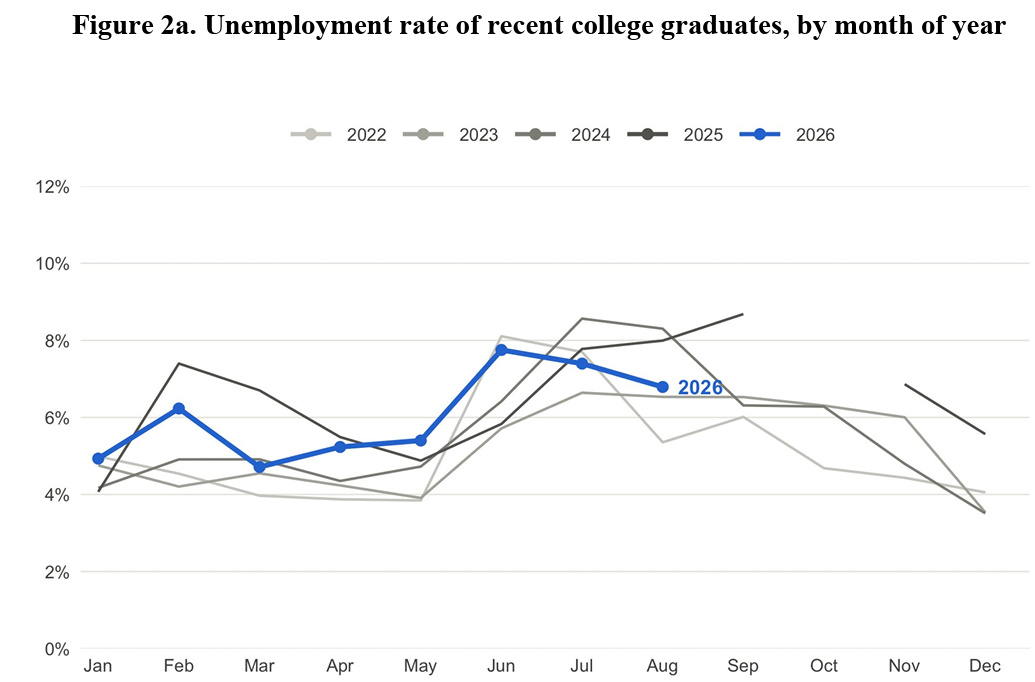
The 2026 jobs market looks incredibly normal for recent graduates. Credit: CESifo

At a base level, the summer unemployment rate for those young college graduates in 2026 (7.3 percent) was well within the range seen in previous years (from 6.3 percent in 2022 to 7.8 percent in 2024). The 2026 numbers were similarly unremarkable when expanded to include graduates who told the CPS survey they "want a job" even though they weren't actively looking for one (and thus don't officially count as part of the official "unemployed" labor force).

To test the robustness of these findings, the researchers created statistical tests to compare the recent college graduates both with non-college graduates in the same age range and with older college graduates (aged 30 to 49). They also broke down employment by potential "AI exposure" based on a 2023 study of which job roles AI systems were best equipped for.

In almost all of the comparisons, any trend differences between the groups in the 2022 to 2026 time frame studied were not statistically significant. Overall, the data “tell a consistent story in which unemployment among recent college graduates in summer 2026 was not unusually high relative to earlier summers” across comparison groups, the researchers wrote.

So how does this analysis square with the recent Stanford study that found an almost completely opposite result? Well, Stanford’s study was based on payroll data from HR firm ADP, which covers a decent cross-section of the economy but might miss some elements of a wider Census survey. The ADP data also looks at the total supply of jobs in various fields, while the unemployment rate being studied here also takes into account the aggregate demand for those jobs. That demand could easily shift even if the supply of jobs in certain fields starts contracting due to AI.

Overall, the CESifo researchers conclude that the Summer 2026 unemployment data serves as a “useful first test” of how accelerating AI usage is—or, as the data show, is not—impacting the current US job market. But current trends do not imply future performance, of course, and the researchers warn that “if the intensity of AI use in the workplace continues to increase, the graduating classes of 2027 and later might be more affected than the class of 2026, and additional years of data will be needed to hone in on whether effects emerge as workplace use of AI deepens.”

Read full article

Comments


Read the whole story
tedgould
4 hours ago
reply
Texas, USA
Share this story
Delete

Where Is the U.S. Beating China on A.I., and Where Is It Lagging?

1 Share
The World Artificial Intelligence Conference in Shanghai in July. China and the United States are locked in an A.I. race that both sides see as decisive to gaining the upper hand militarily, technologically and economically.

Read the whole story
tedgould
2 days ago
reply
Texas, USA
Share this story
Delete

NASA chief: I'm only interested in "good deals" from international partners

1 Share

NASA must be more selective in the way it forges international partnerships as the race to the Moon transforms from a battle for national prestige between the United States and China into a high-stakes competition for extraterrestrial real estate and resources, the agency's administrator said.

Jared Isaacman, now in his 10th month at the helm of the world's largest civilian space agency, told a gathering of military leaders and defense contractors last week near Washington, DC, that the 21st-century race to the Moon is more than a battle of ideologies. The sweet spot for a Moon base, Isaacman said, is a relatively small region near the lunar south pole, and there are tangible implications for who gets there first.

The Moon's south pole harbors substantial quantities of water ice concentrated on the floors of craters away from the reach of sublimating rays of sunlight. The ice inside these eternally dark craters could be used to supply water, air, and rocket fuel for a Moon base, supporting a permanent settlement and providing a springboard for future expeditions to Mars.

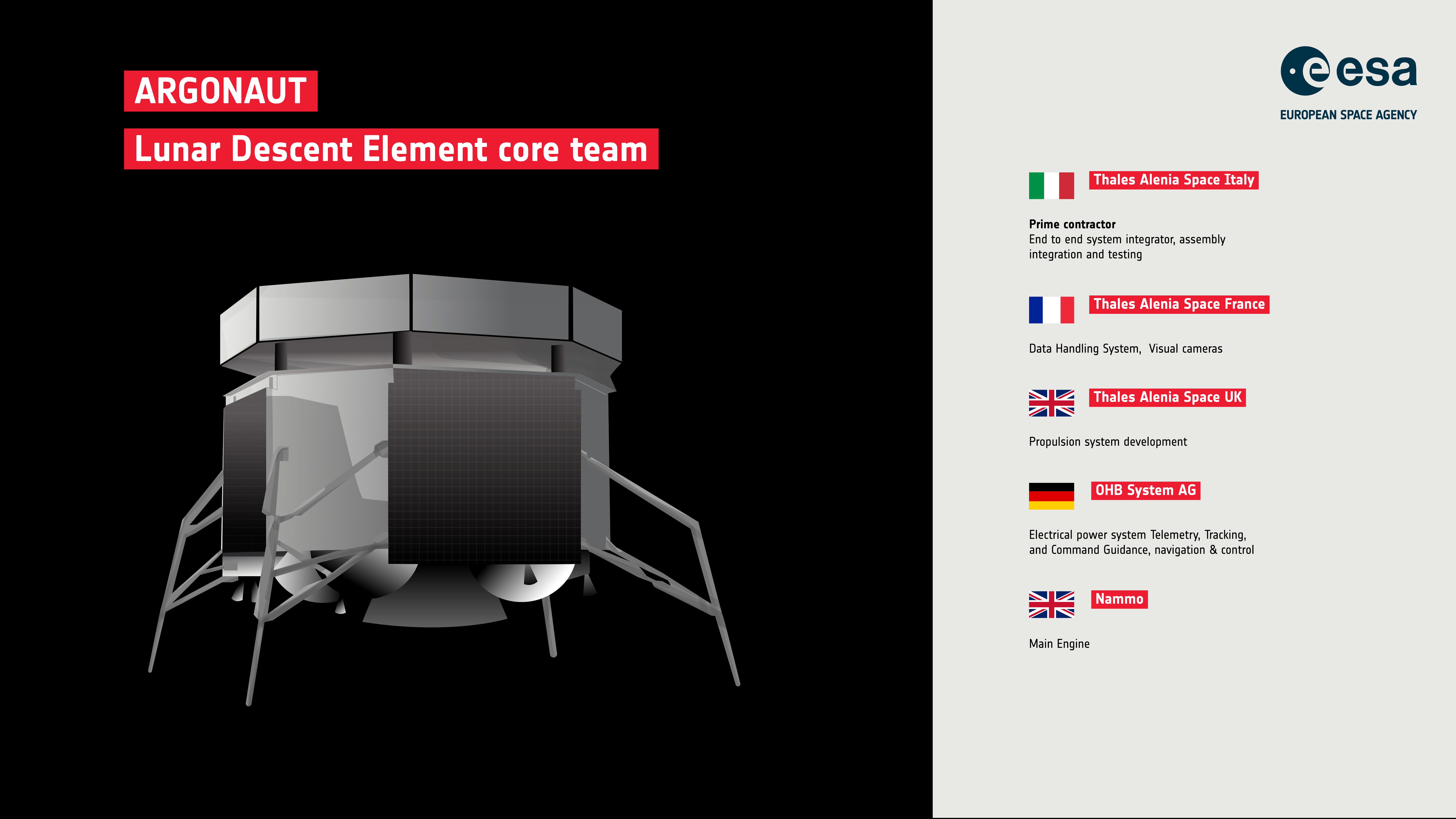
"It's a big Moon, with the surface area of Africa," Isaacman said Wednesday at the Air & Space Forces Association's Air, Space & Cyber Conference. "The south pole is more akin to Washington, DC, when there are only so many roads and so many good parking spots that you're going to want to occupy."

The best parking spots aren't just those close to the Moon's water ice bound up in deep craters. A few select crater ridges extending high above the ice deposits provide access to near-continuous sunlight for power generation.

"We want to go there to master the skills for Mars," Isaacman said. "And when you realize there are only limited parking spots that get us access to that training environment, it creates an urgency, and we must [go fast] because the Chinese are going to the exact same locations. They are partnered with the Russians. They are going to put a nuclear reactor there, and they could potentially deny this training environment that is a necessity for America's space ambitions."

Isaacman said this means NASA must make better decisions on when and how to work with international partners. Other nations have a place in NASA's programs, but only if they can meaningfully contribute to the mission, he said.

"I will tell you, though, and this is right from the top from the president of the United States: We're only doing good deals, and we haven't always done good deals," Isaacman said. "There was absolutely a time where we were trying [to] make everyone happy. Let's get a lot of flags together for a great press release, and it can [be], and absolutely has been, at times, a drag on the mission instead of accelerating it. You can't do that, and we've changed that now, and as a result, good deals are happening."

The rim crest and upper part of the rim of Shackleton Crater, as viewed by NASA's Lunar Reconnaissance Orbiter. The Moon's south pole is located on the rim near the upper-right corner of the image. Credit: NASA/GSFC/Arizona State University
What's a good deal?

Isaacman singled out as a good deal NASA's agreement with the Italian government in March for the development of living quarters for astronauts on the Moon.

"They're committing over $5 billion to building one of the first habitation modules," Isaacman said. "It likely will be the first real habitation module that makes its way to the lunar surface. And as a result, you're going to see two Italian astronauts on the surface of the Moon."

Japan, too, is coming in clutch for NASA, Isaacman said, with a multibillion-dollar commitment to develop a pressurized rover to ferry astronauts across the Moon. In exchange, Japan will likewise get two tickets to the Moon for the country's astronauts. The US and Japanese governments signed the agreement on the pressurized rover in 2024.

"That is the expectation we set for everyone," Isaacman said. "You're not just going to bring us a list and say, 'I will do this regardless if it helps the mission or competes with US industry and what US industry is trying to accomplish on the Moon.' That is not going to work. We need meaningful contributions now. The game has changed."

The role of the European Space Agency, perhaps NASA's most enduring international partner, on the Moon Base program remains undefined. ESA signed up to provide elements for a habitation module, a refueling module, and deep space communications hardware for the planned Gateway mini-space station in orbit around the Moon.

NASA announced the cancellation of Gateway in March in a strategic shift to focus on a permanent presence on the lunar surface, where China has set its sights. It didn't help that Gateway's first pressurized module was corroded.

Canada, too, is weighing its potential contribution to the Moon Base program. The Canadian Space Agency was on the hook to build a robotic arm for the Gateway outpost, improving on the Canadian robotics systems used on the Space Shuttle and the International Space Station. The design and use case for a robotic arm on the surface of the Moon, where it must operate in partial gravity, is different from that in microgravity. It doesn't help that the Trump administration is currently engaged in a trade war with Canada, erecting a hurdle for any potential bilateral agreements.

ESA and Canada received guarantees from NASA for lunar flight opportunities for their astronauts through their agreements on Gateway. ESA also provides service modules for NASA's Orion spacecraft, the ship that carries astronauts between the Earth and the Moon. Canadian astronaut Jeremy Hansen took Canada's first seat on an Artemis mission with the flight of Artemis II around the Moon earlier this year.

NASA announced in June that ESA astronaut Luca Parmitano, a colonel in the Italian Air Force, will serve as pilot on the Artemis III mission to test lunar landers and the Orion spacecraft in low-Earth orbit in 2027.

Rule by committee

ESA's director general, Josef Aschbacher, told reporters in June that he is eager to secure seats for the agency's astronaut corps to land on the Moon. A "meaningful" contribution to the Moon Base program would pay the fare, but it hasn't been easy to find agreement on what that might look like.

NASA's agreement with Italy, an ESA member state, was directly negotiated between the two countries outside the halls of ESA. The European Space Agency has 23 member states, which provide funding in three-year increments, offering a modicum of stability for ESA's programs at the expense of agility.

Italy's commitment to build a habitation module and Japan's contribution of a pressurized rover offer something new to NASA, which didn't have contracts with US companies to do that work. Those are the kinds of partnerships Isaacman said he is looking for.

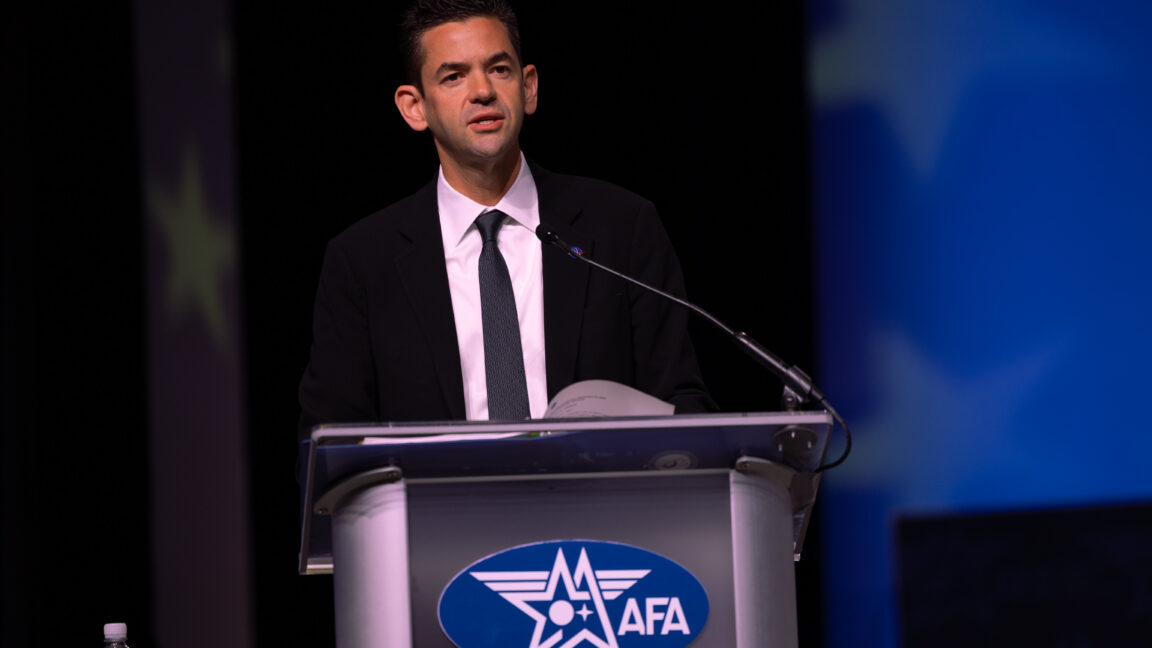
ESA's Argonaut would include elements from across Europe. Credit: European Space Agency
"We had one partner that said, 'Look, I'll give you a lander, a robotic lander, that'll go to Shackleton Crater by the mid-2030s," Isaacman said in a question-and-answer session at the Air, Space & Cyber Conference last week. "I was like, 'The Chinese are launching there in two months (with Chang'e 7, a mission now delayed to early 2027). What good is that to us then? There will be no landing spots available at that point in time.'"

Isaacman did not identify which partner he was talking about, but it almost certainly was ESA, which is seeking a role for its Argonaut cargo lander in NASA's Moon Base program. The problem from NASA's perspective is that Argonaut would replicate much of what US companies are well along in developing.

Each Argonaut lander could deliver to the lunar surface up to 1.5 metric tons (3,300 pounds) of cargo, such as crew provisions, science instruments, and infrastructure, according to ESA. That is half of the payload capacity of Blue Origin's Blue Moon Mark 1 lander, set to make its first flight to the Shackleton Connecting Ridge near the Moon's south pole next year and far below the cargo capability of larger human-rated landers like Blue Moon Mark 2 or SpaceX's Starship.

"We've got to get in touch with reality and make meaningful contributions to what NASA and the free world are trying to achieve with our space ambitions," Isaacman said.

Read full article

Comments


Read the whole story
tedgould
3 days ago
reply
Texas, USA
Share this story
Delete

German Leaders Prepare to Deny Far Right Access to Secret War Plan

1 Share
With the Alternative for Germany party close to power in a German state, federal officials are planning to limit the group’s access to classified intelligence.

Read the whole story
tedgould
3 days ago
reply
Texas, USA
Share this story
Delete

China’s Continued Control of Rare Earths Looms Over Trump-Xi Meeting

1 Share
Manufacturers are struggling with constrained supplies as U.S. and Chinese officials negotiate over export restrictions with consequences for global industry.

Read the whole story
tedgould
3 days ago
reply
Texas, USA
Share this story
Delete

Why America’s AI Dream Is Failing to Launch

1 Share

In 2022, American dominance in AI looked almost unassailable. The U.S. led in advanced models, semiconductors, capital and talent. Its closest competitor, China, appeared to be reeling from export controls that cut it off from the world’s most advanced process nodes, chips and memory technologies.

Four years later, the tide seems to be turning. Chinese models have gained major global token share; American technology giants are eyeing Chinese logic and memory chips; and America’s grand AI ambitions face growing public backlash.

During the first three months of 2026, local opposition blocked or delayed roughly $130 billion in data center projects. This spring, 71% of Americans surveyed opposed the construction of a data center near where they live. Texas, the fastest-growing state in data center construction, has frozen new grid-connected projects until further impact studies are completed. Data centers have become a bipartisan sleeper issue for the election cycle.

Read the whole story
tedgould
3 days ago
reply
Texas, USA
Share this story
Delete
Next Page of Stories