Log in


During a medieval siege, a trebuchet scored a chance hit one unlucky defender. A small boulder slammed into his upper back at close to 300 kilometers an hour, smashing bones and crushing him beneath its weight.
The man’s skeleton lay beneath the chapel of Scotland’s Stirling Castle, along with the remains of several other people who had clearly died violent deaths. But this one, known to us only as Skeleton 150 (or as “trebuchet guy” in your faithful correspondent’s notes), stood out even among that battle-damaged crowd because most of his upper body had been shattered. According to University of Bradford paleopathologist Jo Buckberry, who presented her research at the 25th European Meeting of the Paleopathology Association last week, skeleton 150 is the only known trebuchet casualty in history.
A shattered skeleton
Skeleton 150 was in terrible shape, even for a dead guy. The man’s skull had broken in 61 separate places, and another 60 jagged bits of bone were distributed across his ribs. His right shoulder was broken, and his right leg above the knee was basically shattered.
Buckberry and her colleagues threw everything they could, metaphorically speaking, at the jigsaw puzzle of broken bones: forensics, microscopes, X-rays, and micro-CT scans. All of those results pointed to a single moment of crushing impact by something heavy and fast-moving. The pattern of the injuries suggests that the man’s right shoulder and the back of his head caught the brunt of the impact, while his ribs probably cracked under the weight of something heavy slamming him into the ground and pinning him there.
The bones had broken when they were fresh, so it was clearly not a case of “oops, we dropped a big rock on the corpse.” And the amount of force required to do so much damage in a single, shattering blow ruled out several messy possible ways to die during a medieval siege: Skeleton 150 hadn’t been trampled by a horse or run over by a cart, for example. Even if he had fallen from the castle walls, he probably wouldn’t have landed with enough force to do all of that, and the angle would have been all wrong.
"The most similar cases I was finding were car crashes and people hit by trains," Buckberry told Science.org’s Andrew Curry. Assuming Stirling Castle hadn't been attacked by time-travelers, though, that raised new questions. "What is large and moving very quickly in 1304?"
Big rocks flung by trebuchets, that's what.
The physics of throwing big rocks
A trebuchet works a bit like the world's deadliest see-saw; at the long end of the see-saw is the sling that holds the projectile, and at the shorter end is a counterweight (a box of rocks or lead, 10 to 100 times heavier than the projectile). When the counterweight drops, its momentum raises the other end of the see-saw, tossing the sling up in a big arc. And when the sling reaches the end of its length, it stops—but the projectile keeps flying until it hits something.
A typical trebuchet of the time could launch a 90-kilogram projectile (typically a big rock) a few hundred yards. According to this handy medieval trebuchet calculator, that means the projectile would have smashed into Skeleton 150 at somewhere between 200 and 300 kilometers per hour, depending on the exact weight of the projectile and the trebuchet’s counterweight, the length of the sling, and the airspeed velocity of an unladen swallow. That’s an impact with a little over 200 kilojoules of energy.
Trebuchets and other siege engines (we will, under no circumstances, be delving into the distinctions between the different types of catapult) were meant to take out walls and other fortifications. They weren’t antipersonnel weapons; people undoubtedly got injured by flying debris or collapsing structures, but medieval engineers weren’t aiming their catapults at individuals. Skeleton 150 just got terribly unlucky.
"While the use of siege engines is well-documented, we believe this is the first evidence of trebuchet trauma in the archaeological record," wrote Buckberry, adding, "The lack of directly comparable forensic cases remains a limitation."
 Please do not, though.
Credit:
Kiona Smith
Please do not, though.
Credit:
Kiona Smith
Who was Skeleton 150? Scottish, probably
Skeleton 150 was one of nine people found in graves beneath the castle’s medieval chapel, to the surprise of renovation workers, in 1997. Five of the dead had wounds that suggested they had died violent deaths: a middle-aged woman had suffered two heavy blows to the side of her head before falling and being struck with a war-hammer, which left a pair of eerily-neat square holes in the top of her skull. A teenage boy had been stabbed in the chest with a sharp weapon that left its mark on his ribs, then struck hard in the jaw, collarbone, and torso.
It’s hard to say exactly who any of these people were, besides obvious medieval wartime casualties. All five of their remains radiocarbon dated to around the Scottish Wars of Independence in the early 1300s, during which Stirling Castle was hotly contested real estate; it changed hands five times just in the eight years between 1296 and 1304, and the wars carried on until 1357. So some of the people buried in the chapel may have been Scottish, and others may have been English.
At least one of the dead, whose skeleton bore the marks of a lifetime of healed wounds, turned out to be an English knight, Sir John de Stricheley, who died in 1341. The ratio of chemical isotopes in his bones suggested that he had grown up eating food grown on the bedrock of southern England, and that, combined with his age and apparent status, pointed to an English knight. Sir John de Stricheley died at the castle in 1341 (and was important enough to have his death written down properly).
Buried not far from Sir John and the others lay skeleton 150, who Buckberry and her colleagues say was most likely a Scottish defender of the castle killed during the siege of 1304, when King Edward I of England laid siege to Stirling Castle with what Historic Environment Scotland describes as “possibly the largest array of siege engines ever assembled by the kingdom of England.”
Setting the stage
In 1304, Skeleton 150 was probably one of the 25 men, led by Sir William Oliphant, who made up the last gasp of Scottish resistance against England and Edward I. After defeating William "They Will Never Take Our Freedom" Wallace at the Battle of Falkirk in 1298, Edward spent the next six years conquering the rest of Scotland. The country's nobles eventually surrendered in exchange for being allowed to keep their lands (some of them may have done so with their fingers crossed). Edward’s long and bloody campaign was nearly over, except for this one castle, which inconveniently happened to perch along a strategically important road to Edinburgh. And the king was not amused.
In preparation for the siege, Edward decided to flex his newly won power over the Scots, which was undoubtedly as much a political gesture as a strategic choice. He ordered the Scottish nobles who had just surrendered to send him troops and horses for the siege, and he ordered that every church in Scotland strip the lead from their roofs and send it to the siege as well. Thirty-nine carts of lead arrived from around Scotland, mostly from St. Andrew's, along with "all the iron and great stones of Glasgow."
Thirteen siege engines were in place when Edward I arrived on the scene in April of 1304, and they bombarded the castle around the clock for three solid months. Somewhere during those months, Skeleton 150 met a bad end.
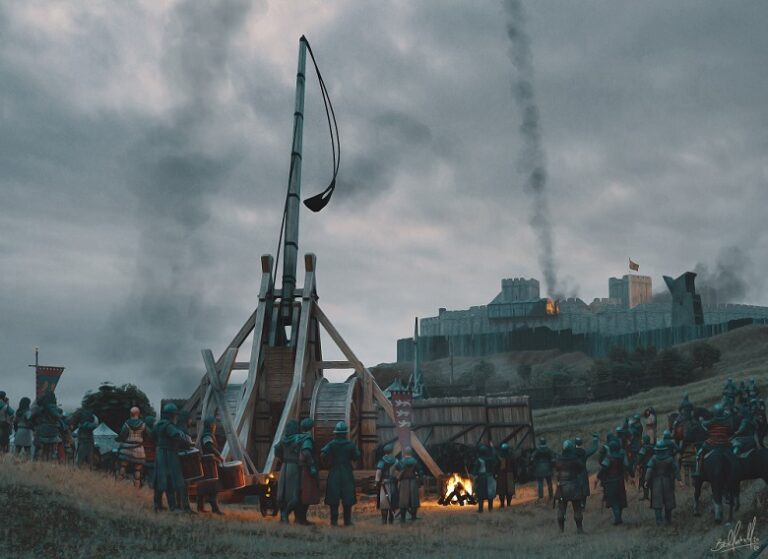 The War Wolf, probably not the trebuchet that killed Skeleton 150.
Credit:
Bob Marshall, HES
The War Wolf, probably not the trebuchet that killed Skeleton 150.
Credit:
Bob Marshall, HES
The War Wolf
As the siege wore on, Edward I set his engineers and carpenters to work on the largest trebuchet anyone in the world had ever seen. He dubbed it the War Wolf, or Loup de Guerre, and it was an absolute monster—so much so that Oliphant, who had held the castle for three months and still had enough men and provisions to keep antagonizing the king for a while yet, decided that actually, he would very much like to surrender after all, before the giant trebuchet took the field, thank you very much.
And Edward I told him no.
The king was not going to miss the chance to use his tremendous new trebuchet, nor the chance to very publicly and definitively (and also literally) crush the last of the Scottish opposition to his reign. So he ordered his engineers to load the War Wolf and fling a 140-kilogram projectile straight through the castle's curtain wall. Witnesses compared it to watching an arrow pierce a paper target.
It's tempting to speculate that Skeleton 150 might have been a casualty of the infamous War Wolf itself, but that seems unlikely. For one thing, the odds just aren't in favor of the theory; the War Wolf flung a single, albeit enormous, shot on the very last day of the siege. Thirteen other siege engines had been firing at all hours of the day and night for three months before that.
He was probably dead and hastily buried in the chapel by the time the castle walls crumbled and Oliphant and the other survivors were rounded up and taken south to prison in England.