Log in


The proliferation of nuclear power in space got a little more real Tuesday with the launch of a small satellite developed by a Florida-based company specializing in nuclear micro-power technology.
It's a long way from launching a bona fide nuclear reactor, a breakthrough that could help power a permanent Moon base and efficiently drive rockets throughout the Solar System. But you have to start somewhere.
The satellite from Miami-based City Labs is named BOHR, short for Betavoltaic Orbital High-Reliability, and it launched on a SpaceX rideshare mission Tuesday alongside 80 other payloads. SpaceX's Falcon 9 rocket released the BOHR satellite into an orbit between 350 and 400 miles (nearly 600 km) in altitude.
Starting small
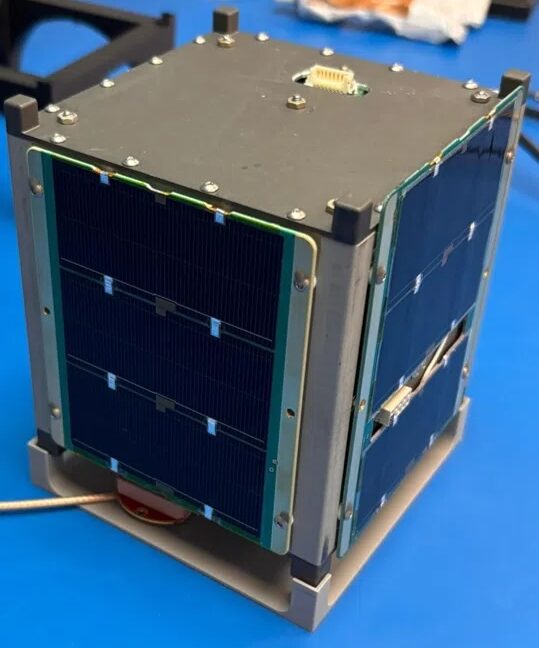
City Labs bills the BOHR mission as "the world's first commercial nuclear-powered satellite and first nuclear CubeSat." CubeSats are modest in scale, and images released by City Labs suggest BOHR is built on a "1U" CubeSat platform, a cubical design measuring about the same size as a softball. BOHR's power source is a nuclear betavoltaic battery that generates electricity from the decay of tritium, a radioactive isotope of hydrogen.
"This is a historic step for commercial nuclear power in space," said Peter Cabauy, CEO of City Labs, in a statement. "BOHR demonstrates that safe, compact, and regulatory-approved nuclear power systems are ready for routine commercial deployment. This capability enables persistent, always-on payload operations that are not constrained by sunlight or battery life."
City Labs will use its experimental NanoTritium power generator in demonstration mode to supply electricity to a payload onboard the BOHR CubeSat. The spacecraft itself uses conventional solar power for regular operations, the company said. Betavoltaic batteries are best suited for low-power applications that require a reliable, long-duration source of electricity. These use cases include remote terrestrial sensors—such as in undersea or polar locations—and instrumentation for secure communications. City Labs is also studying the use of its NanoTritium technology to power implantable medical devices.
The space industry is the other near-term market for City Labs. NASA has worked with City Labs to look at using nuclear tritium power sources to support a network of small sensors that could be deployed into permanently shadowed craters on the Moon to scout for resources like water ice. The US Air Force and Space Force have given City Labs several research contracts, funding the development of an experimental tritium AA battery for cryptographic devices and a self-powered wireless autonomous imaging sensor. City Labs says its betavoltaic systems could also power heaters for microelectronics in harsh environments.
It's important to remember that the company's betavoltaic power systems are small—in the nanowatt to microwatt range—far short of the electricity required to power a smartphone, much less a large spacecraft or a Moon base. Still, the BOHR mission is a step in the right direction for proponents of nuclear power in space. Until now, nuclear-powered spacecraft have been solely owned by government agencies like NASA and the US military.
Commercial nuclear-powered space missions face regulatory hurdles, and BOHR was the first commercial nuclear mission to pass through the Federal Aviation Administration's new nuclear launch approval process. The FAA authorized City Labs to launch the BOHR mission last September.
It helped that the BOHR satellite carries just a tiny amount of radioactive material, and the tritium isotope decays more quickly than plutonium or uranium. It's also less toxic than other well-known nuclear fuels. "Tritium emits a weak form of radiation, a low-energy beta particle similar to an electron. The tritium radiation does not travel very far in air and cannot penetrate the skin," the Nuclear Regulatory Commission says on its website.
Future missions will have to launch with far more nuclear material than City Labs' BOHR mission, but this week's launch served as a first step.
"The BOHR mission serves as a pathfinder for future nuclear-powered spacecraft supporting both civil and national security missions," City Labs said in a statement.